Car Accident Expert Witness: What They Analyze and Prove
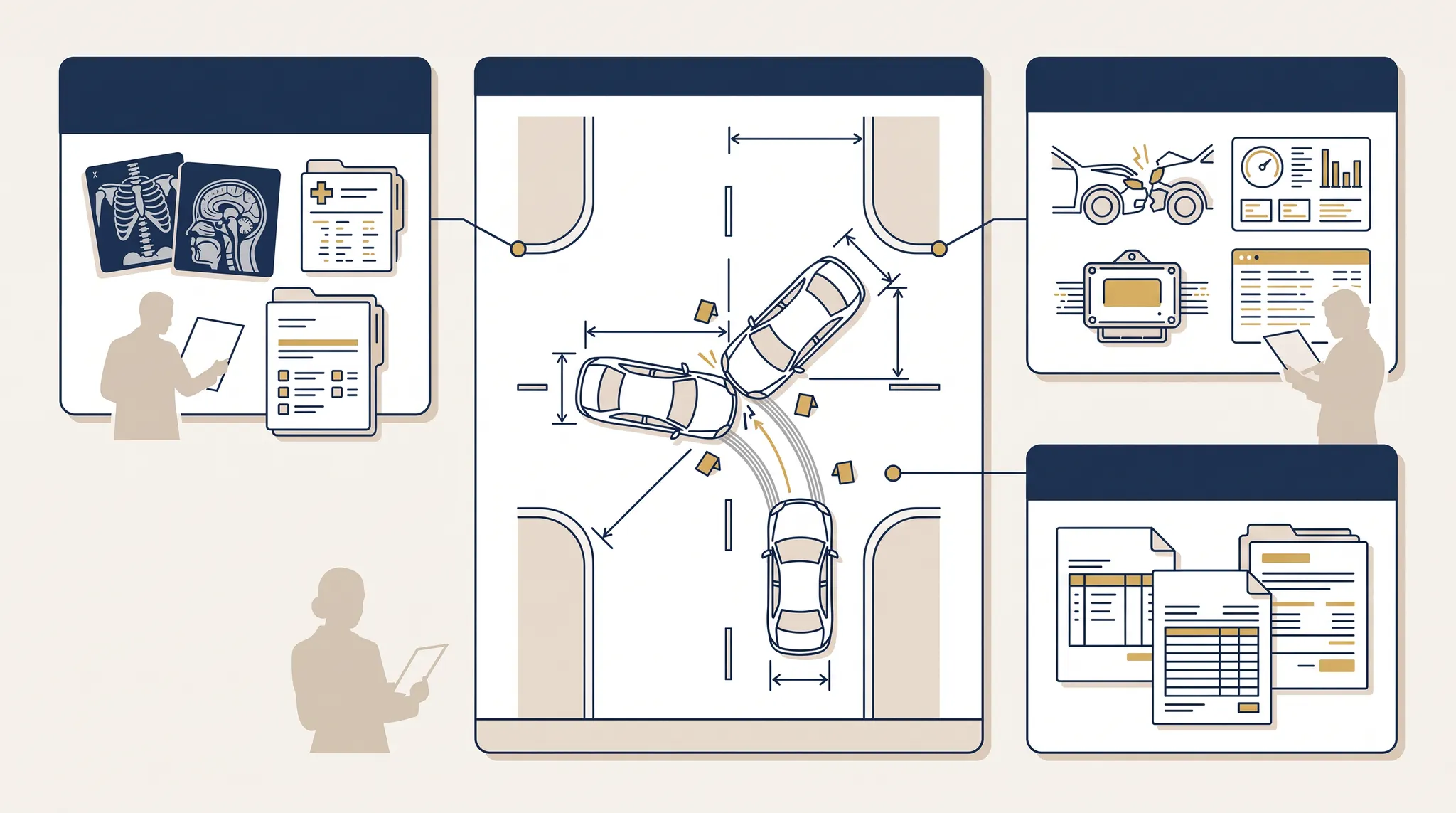
A car accident expert witness uses scientific, technical, medical, vocational, or economic knowledge to explain a disputed issue that ordinary testimony cannot fully resolve. The useful question is not simply whether a case has an expert. It is whether a qualified specialist can connect reliable evidence to a specific issue without exceeding the limits of the specialist’s field.
An expert is not a substitute for missing facts. A sound opinion identifies the question, the evidence reviewed, the method used, the assumptions made, alternative explanations considered, and the point where the available information no longer supports a conclusion.
When a car accident expert witness may matter
Expert work is most useful when an important dispute depends on specialized analysis rather than ordinary observation. Common examples include:
- how vehicle movement, impact geometry, braking, or roadway conditions relate to the collision sequence;
- whether documented injuries and treatment are medically related to the crash;
- what future care may be reasonably needed and why;
- whether a vehicle component, restraint, tire, roadway feature, or commercial practice contributed to the event;
- how an injury affects work capacity, future earnings, or the cost of care;
- whether digital, imaging, or testing data supports or contradicts a claimed sequence.
Not every disagreement needs an expert. A traffic-light color personally observed by a witness, an undisputed repair invoice, or a photograph that speaks clearly for itself may not require specialized interpretation. The decision should begin with the disputed question—not with a list of impressive credentials.
Match the disputed question to the right specialty
“Accident expert” is too broad. Different questions call for different training and methods.
| Disputed question | Possible specialty | Typical evidence reviewed | Important limit |
|---|---|---|---|
| How did the vehicles move and collide? | Accident reconstruction, engineering, biomechanics | Scene measurements, photographs, video, vehicle damage, event data, roadway geometry | Reconstruction may explain mechanics without deciding legal fault |
| Did the crash cause or worsen an injury? | Treating or reviewing medical specialist | History, examinations, imaging, prior records, treatment, differential considerations | A physician should stay within the physician’s actual specialty and record basis |
| Will future treatment or assistance be needed? | Medical specialist, life-care planner | Prognosis, recommendations, functional limits, care plans, cost sources | Future needs should not be presented as certain when the evidence supports only a range |
| Did the injury reduce work capacity? | Vocational rehabilitation or economics | Work history, restrictions, education, labor data, tax and wage records | Economic calculations depend on the vocational and factual assumptions supplied |
| Did a vehicle or roadway condition contribute? | Mechanical, automotive, human-factors, or roadway engineer | Inspections, maintenance, design records, warnings, testing, standards | The expert must separate observed defects from speculation about causation |
One specialist may answer only one layer of a problem. For example, a reconstructionist may estimate motion from physical evidence, a physician may address injury causation, and an economist may calculate a loss using medical and vocational assumptions. Combining those roles without the necessary qualifications can weaken the analysis.
Build an evidence-to-opinion chain
A persuasive expert analysis should be traceable from source material to conclusion. Organize the file in five steps:
- Question: State the exact disputed issue the expert is being asked to analyze.
- Source evidence: Identify photographs, measurements, records, testimony, physical items, digital data, literature, or testing actually considered.
- Method: Explain the principles, calculations, comparison process, examination, or professional reasoning used.
- Assumptions and alternatives: Separate established facts from assumed facts and address plausible competing explanations.
- Conclusion and limits: State what the analysis supports, the confidence or range if appropriate, and what cannot be determined from the available evidence.
This chain makes gaps visible. If a speed estimate depends on an unverified road grade, or a future-loss calculation assumes a medical restriction no provider has expressed, the weakness should be identified rather than hidden inside a final number.
Our guide to preserving car accident witness information explains how firsthand observations differ from technical opinions. The car accident deposition guide covers how testimony and source records are tested after a lawsuit begins.
What an accident reconstruction expert may analyze
A reconstruction specialist may examine scene geometry, final vehicle positions, crush patterns, tire or roadway marks, photographs, video timing, traffic controls, visibility, vehicle specifications, event data, inspections, and witness accounts. Which sources are reliable depends on how they were created, preserved, and matched to the event.
A reconstruction should not begin with a desired answer. It should test whether the physical and digital evidence can support one or more collision sequences. Conflicts matter: photographs may not show the full roadway, a vehicle may have moved before documentation, video can distort distance, and downloaded vehicle data may require qualified interpretation.
Preservation can be time-sensitive. Vehicles are repaired or sold, roadway marks disappear, surveillance systems overwrite files, and device data changes. Do not alter a vehicle, discard a component, or rely on a screenshot as the only copy of digital evidence without case-specific guidance.
Medical, vocational, and economic experts answer different questions
Medical causation requires more than placing a diagnosis next to a crash date. A medical analysis may consider the force history, symptom timing, examinations, imaging, prior conditions, later events, treatment response, and alternative causes. The record should distinguish what the patient reported, what the provider observed, and what testing showed.
Future-care opinions should identify the clinical basis, expected frequency or duration, alternatives, and uncertainty. Vocational analysis may evaluate restrictions, transferable skills, education, work history, and labor-market access. Economic analysis can then apply supported assumptions to wage records, benefits, work-life estimates, discounting, or care costs.
A precise calculation is not automatically a reliable one. If the underlying medical restriction, work assumption, or cost source is unsupported, additional decimal places do not repair the foundation.
How Nevada law frames expert testimony
Nevada law generally permits expert testimony when scientific, technical, or other specialized knowledge will assist the fact-finder and the witness is qualified by knowledge, skill, experience, training, or education. See NRS 50.275. The permitted scope depends on the expert’s qualifications and the subject at issue.
Nevada’s evidence statutes also address the facts or data underlying an expert opinion and allow that foundation to be examined on cross-examination. In a Nevada district-court civil case, NRCP 16.1 generally requires disclosure of testifying experts and specifies information required for retained-expert reports, subject to stipulations, court orders, and the rule’s distinctions for other witnesses.
These rules do not make every disclosed opinion admissible or persuasive. Qualifications, fit, methodology, factual foundation, disclosure compliance, and case-specific rulings can all matter. An attorney should evaluate the current statutes, rules, scheduling order, local practice, and evidence in the actual case.
Questions that test an expert opinion
Whether reviewing your own expert or an opposing opinion, ask:
- What precise issue is this expert qualified to address?
- Which facts were measured, observed, supplied, or assumed?
- Are the important source materials complete and authentic?
- Can another qualified person reproduce or evaluate the method?
- What alternative explanation was considered and why was it accepted or rejected?
- Did the expert move from technical analysis into a legal conclusion or another specialty?
- Has new evidence changed an earlier assumption?
- Does the report state uncertainty and limitations as clearly as its conclusion?
The goal is not to find an expert who sounds certain. It is to determine whether the opinion remains useful when every link in the evidence chain is examined.
What to do if your case may need an expert
Preserve the underlying evidence before choosing a conclusion. Keep original photographs and videos, vehicle and repair information, medical and wage records, witness details, and insurer communications. Avoid destructive testing, vehicle changes, or new annotations to original files without advice.
Then define the disputed question and identify the discipline that can answer it. For the broader procedural sequence, use our car accident lawsuit process guide.
If responsibility, injury causation, future care, or lost earning capacity is being disputed, check your case in 60 seconds before evidence changes or deadlines pass.
This article provides general information, not legal advice. Expert qualifications, disclosures, admissibility, preservation duties, deadlines, costs, and permissible opinions depend on the jurisdiction, court, orders, evidence, and facts. Consult a licensed attorney about your situation.
Frequently Asked Questions
What does a car accident expert witness do? +
A car accident expert witness applies specialized knowledge to a defined disputed issue, such as collision mechanics, injury causation, future medical needs, vehicle systems, lost earning capacity, or another technical subject. The expert should explain the methods, facts, assumptions, and limits supporting the opinion.
Does every car accident case need an expert witness? +
No. Many issues can be evaluated through photographs, records, admissions, and firsthand testimony. Expert work is more likely to matter when an important issue requires scientific, medical, engineering, vocational, or economic analysis beyond ordinary experience.
Can an expert witness decide who wins a car accident case? +
No. An expert may offer a permitted opinion within the expert's field, but the judge controls admissibility and the fact-finder determines credibility, disputed facts, responsibility, and damages under the applicable law and instructions.
What should be preserved for a possible accident reconstruction expert? +
Potentially useful material can include scene and vehicle photographs, video, vehicle data, repair and inspection records, measurements, diagrams, witness information, crash reports, damaged components, and device data. Preservation needs are case-specific, so seek legal guidance before a vehicle or digital source changes.
Injured in a Las Vegas accident?
Find out what your case is worth in under 60 seconds. Free, confidential, no obligation — and no fee unless we win.
Check My Case in 60 Seconds