Car Accident Fault Determination: How Evidence Is Weighed
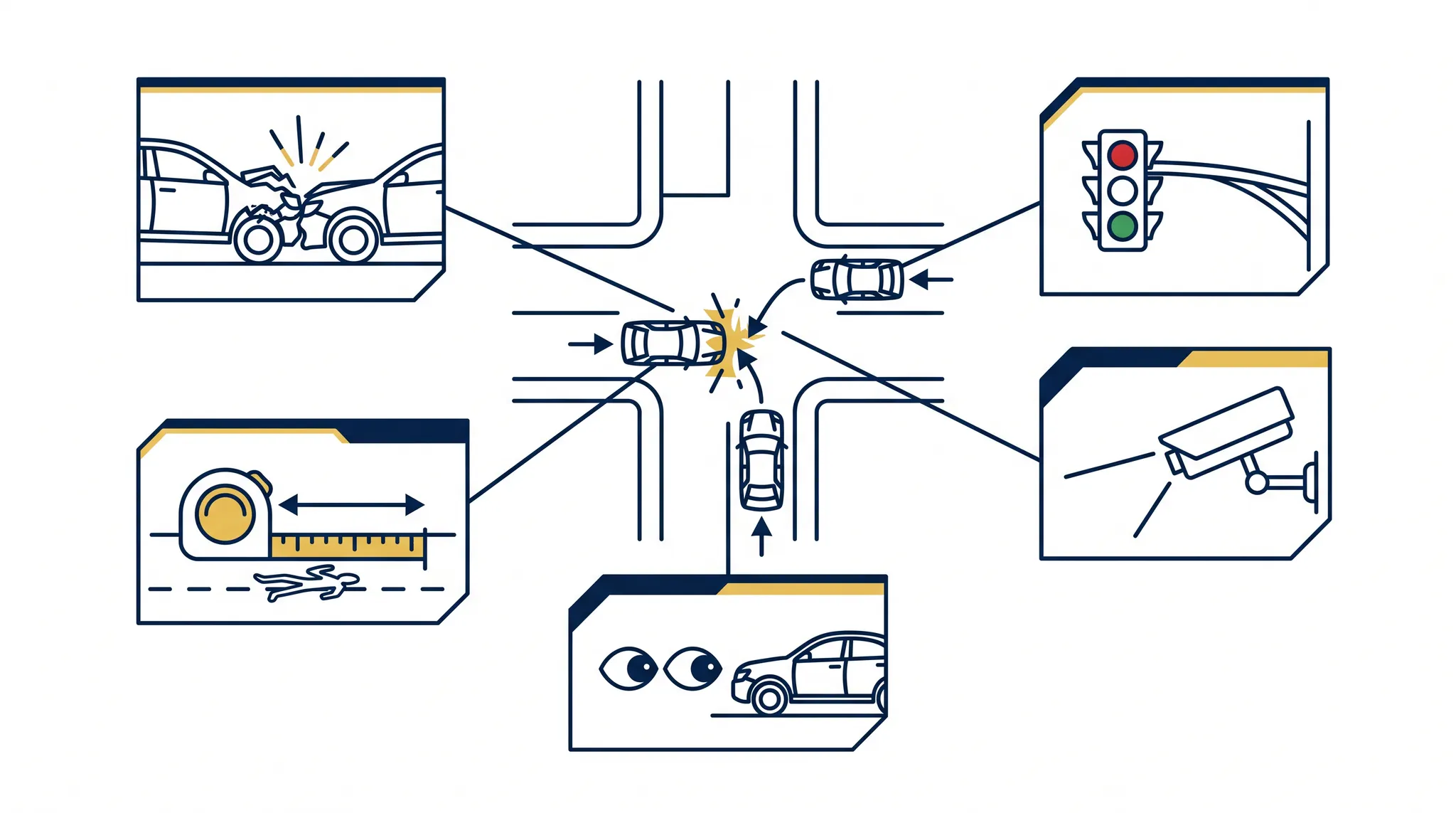
Car accident fault determination is the process of comparing each driver’s conduct with the physical evidence, traffic rules, witness accounts, digital records, and claimed sequence of events. An insurer may make an early liability decision, but that decision is not automatically final. Strong fault analysis shows how each source supports or conflicts with a specific fact.
A useful question is not simply, “Who caused the crash?” Ask which act created the danger, whether another person had time and distance to respond, and which evidence verifies that sequence.
Fault determination starts with a disputed-fact list
Begin by separating agreed facts from disputed facts. This prevents the loudest statement from becoming the working assumption.
| Question | What may verify it | Common weakness |
|---|---|---|
| Which vehicle entered the conflict area first? | Video, signal timing, positions, independent witnesses | Estimates made after vehicles moved |
| What direction and lane was each vehicle using? | Road markings, debris, tire marks, camera views | A diagram with no measurements |
| What traffic control applied? | Signal phase data, signs, lane arrows, road design | A photo taken from the wrong approach |
| Did either driver brake or steer? | Event data, tire marks, video, damage angles | Assuming no marks means no reaction |
| Was visibility limited? | Lighting, weather, obstructions, sight-distance photos | Daytime reconstruction of a night crash |
| Did a violation contribute to impact? | Verified timing and movement evidence | Treating a citation as complete causation proof |
Write each disputed point as a question. Place the supporting and conflicting sources beside it. If a source does not answer a disputed question, it should not carry more weight merely because it looks official.
Physical evidence tests the collision story
Vehicle damage, final rest positions, debris, fluid, gouges, tire marks, road geometry, and measurements can test whether a proposed movement is physically plausible.
Damage alone rarely tells the entire story. A crushed corner may help identify an impact angle, but it may not establish the signal phase, speed, visibility, or what happened seconds earlier. Final positions can also change when vehicles spin, roll, are moved for safety, or receive a second impact.
Preserve wide, medium, and close views. Keep the original files with their metadata. Photograph all sides of each vehicle, the full intersection or roadway, lane markings, signs, signals, obstructions, and the route each vehicle traveled. The car accident checklist explains how to build a time-based record without overlooking the scene context.
Video and digital records need source verification
Dash cameras, business surveillance, doorbell cameras, traffic systems, phone records, navigation history, and vehicle data may help establish movement or timing. Their value depends on authenticity, completeness, and context.
Check:
- who created or controlled the recording;
- whether the file is the original or an edited copy;
- whether the timestamp is accurate;
- whether the recording starts before the disputed event;
- what falls outside the camera’s field of view; and
- whether the source can be preserved before routine deletion.
A short clip can be misleading when it excludes the approach to the collision. A camera angle can hide a signal, lane line, or vehicle. Preserve the full recording and document how the copy was obtained. For a detailed preservation method, use the dash-cam evidence guide.
Witness accounts are tested against opportunity to observe
A credible witness account identifies the observation point, direction of view, distance, lighting, obstructions, duration, and what the witness actually perceived.
Separate direct observation from later information. “I saw the light turn red before the sedan entered” is different from “someone told me the sedan ran the light.” Record uncertainty rather than filling gaps. A careful witness who identifies a limit may be more reliable than a confident witness who could not see the critical area.
Compare each account with video, damage, roadway layout, and other independent sources. Similar wording across statements can also raise a question about whether witnesses discussed the event before recording their memories. The car accident witness guide provides a neutral statement structure.
Police reports are evidence sources, not automatic verdicts
A crash report may identify drivers, insurers, witnesses, road conditions, vehicle positions, statements, citations, and an officer’s diagram or opinion. It can be important, especially when prepared promptly.
Still, separate four categories:
- facts the officer personally observed;
- statements attributed to drivers or witnesses;
- measurements, photographs, or tests;
- conclusions or codes entered after the investigation.
An officer who arrived after the crash may not have seen the collision. A citation may address a traffic offense without resolving every issue of civil negligence. An error in a report should be challenged with a specific correction and supporting source, not a broad accusation.
Traffic rules matter only when connected to causation
A traffic rule helps define expected conduct, but fault analysis still asks whether the conduct contributed to the crash and resulting harm.
For example, speed can affect stopping distance and impact severity, but a speed allegation needs a foundation. A turn violation may be central at an intersection, while a separate equipment issue may have no causal connection. The analysis should connect:
duty or traffic rule → conduct → hazardous sequence → collision → claimed harm
If one link is missing, the conclusion may be overstated. Build a separate line for each driver instead of assuming one mistake eliminates the other driver’s conduct.
Nevada can assign a percentage of fault to more than one party
Nevada Revised Statutes 41.141 addresses comparative negligence. In general, an injured plaintiff’s negligence does not bar recovery when it is not greater than the negligence of the party or combined parties against whom recovery is sought. When recovery is allowed, the plaintiff’s damages can be reduced by the percentage of negligence assigned to the plaintiff.
That means fault determination may involve more than a yes-or-no label. The record may need to address the conduct of both drivers and, in some cases, other parties such as an employer, vehicle owner, contractor, or entity responsible for a condition.
Do not apply a percentage before the facts are developed. “Twenty percent at fault” is not meaningful unless the decision explains the conduct, evidence, legal rule, and comparison supporting that number. Nevada-specific applications and exceptions require attorney review.
Insurance fault decisions should be audited in writing
The Nevada Division of Insurance explains that, after a reported accident, insurers open claim files and investigate to determine liability. An insurer’s position can affect payment and negotiation, but it is still a claim decision based on the information available to that insurer.
When you receive a fault decision, request or organize:
| Audit item | Question to answer |
|---|---|
| Decision | What percentage or liability position was assigned? |
| Factual basis | Which acts or omissions support it? |
| Evidence | Which photos, video, statements, reports, and records were reviewed? |
| Missing material | What relevant source was unavailable or ignored? |
| Conflicts | How did the adjuster resolve contradictory evidence? |
| Policy effect | Which payment or coverage decision follows from the conclusion? |
| Reconsideration | What procedure and deadline apply to a response? |
Respond point by point. Attach the source that corrects each fact. Keep proof of delivery. Avoid changing a truthful account simply to fit a preferred theory.
Build a fault file that another reviewer can reproduce
A reliable fault file lets a new reviewer trace every conclusion back to its source. Use six folders:
- Scene: original photos, diagrams, measurements, road and weather conditions.
- Vehicles: damage photos, estimates, inspection material, event data if available.
- Digital: full video files, preservation requests, source and transfer notes.
- People: driver accounts, independent witness statements, contact information.
- Official: crash report, citations, agency records, signal or roadway material.
- Issue sheet: each disputed fact, evidence for and against, missing source, next action.
Keep originals unchanged. Work from copies. Date every addition and correction. This structure helps expose whether a disagreement is about facts, source reliability, traffic law, causation, or the percentage assigned.
If fault is disputed and you were injured, request a free 60-second case evaluation so the evidence and deadlines can be reviewed together.
This article provides general information, not legal advice. Fault, admissibility, insurance duties, comparative negligence, and deadlines depend on the facts, policy, jurisdiction, and current law. Nevada-specific statements should be reviewed by a licensed attorney.
Frequently Asked Questions
Who determines fault after a car accident? +
Insurance adjusters make claim decisions, but their conclusions are not court judgments. If fault remains disputed, the parties may negotiate, use a contractual dispute process, or ask a judge or jury to decide based on admissible evidence and applicable law.
Does a police report decide who was at fault? +
A police report can preserve observations, statements, diagrams, citations, and identifying information, but it does not automatically control an insurer or court. Its weight depends on what the officer personally observed, what came from others, and whether other evidence supports or contradicts it.
Can both drivers be at fault in Nevada? +
Yes. Nevada law can compare negligence among the parties. Under NRS 41.141, an injured plaintiff is not barred when the plaintiff's negligence is not greater than the negligence of the party or combined parties from whom recovery is sought, although any recovery may be reduced by the plaintiff's assigned percentage.
What should I do if the insurer assigns me fault without explaining why? +
Ask for the decision and factual basis in writing. Request the evidence considered, identify missing or inaccurate facts, preserve your own source files, and respond with a dated issue-by-issue correction rather than an unsupported conclusion.
Injured in a Las Vegas accident?
Find out what your case is worth in under 60 seconds. Free, confidential, no obligation — and no fee unless we win.
Check My Case in 60 Seconds