Uninsured Motorist Claim: Nevada Evidence Guide
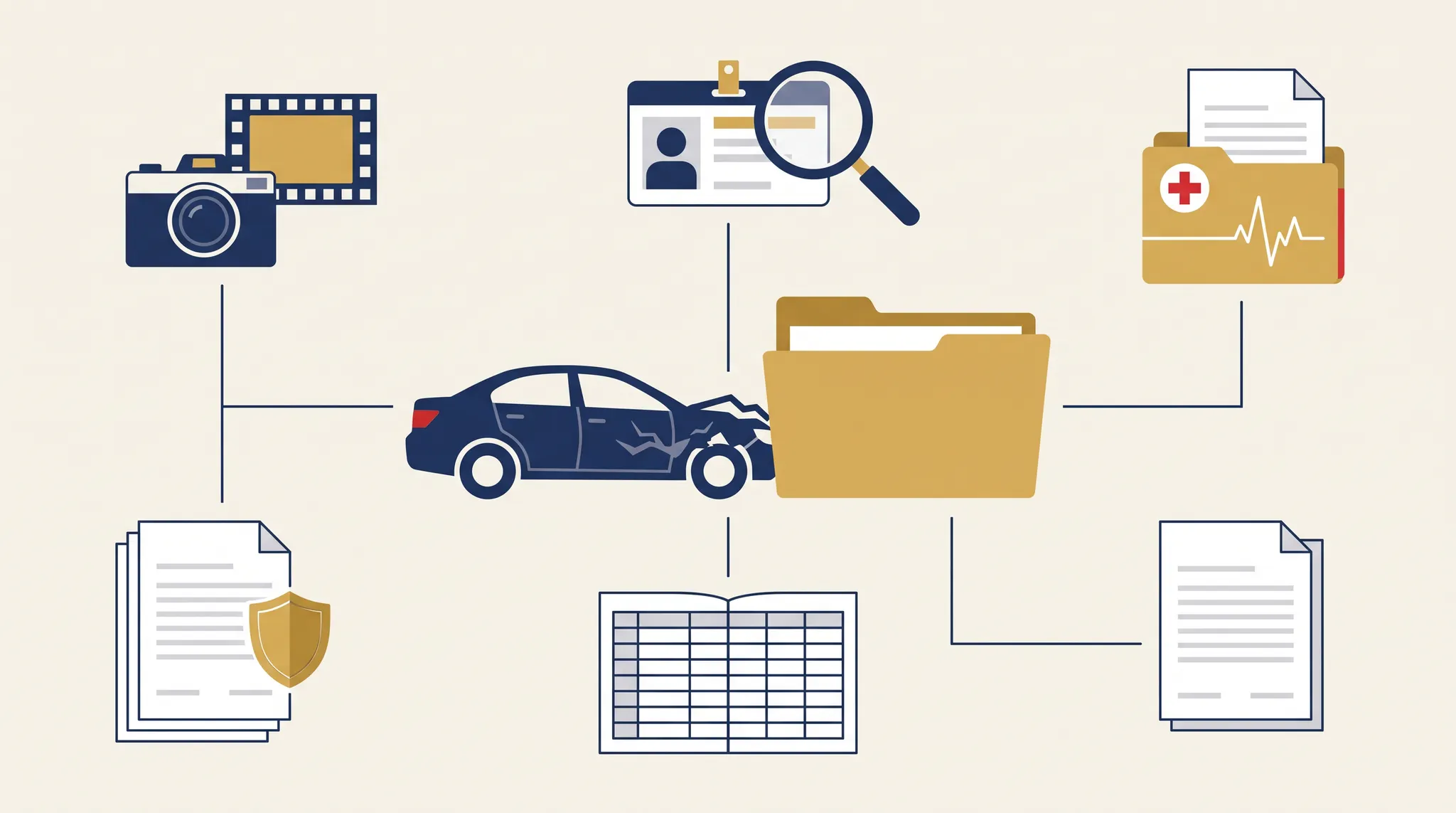
An uninsured motorist claim asks your own insurer to pay covered bodily injury damages when the responsible driver has no qualifying liability insurance. An underinsured motorist claim may apply when that driver’s available limits are not enough. You still need two complete files: one proving the UM/UIM coverage trigger and another proving fault, injury causation, and damages.
In Nevada, UM/UIM coverage is optional for the buyer, but insurers must offer it. The declarations page alone may not answer every question. Review the full policy, endorsements, and any signed selection or rejection form before assuming coverage exists or does not exist.
Identify the uninsured motorist claim trigger
Start by naming the exact coverage problem. Do not use “uninsured” and “underinsured” as interchangeable labels.
| Claim path | Basic question | Records to obtain |
|---|---|---|
| Uninsured motorist | Did the responsible driver lack qualifying bodily injury liability insurance? | Police or crash report, driver and vehicle information, carrier verification, denial or no-coverage letter |
| Underinsured motorist | Are the responsible driver’s available bodily injury limits lower than the supported damages? | Liability declarations or limits confirmation, payment information, UM/UIM policy and endorsements |
| Hit-and-run | Does the policy treat the unidentified vehicle as uninsured, and were notice and reporting conditions met? | Police report, scene evidence, witness details, video, prompt written notice to the insurer |
| Coverage denial or insolvency | Did a carrier deny coverage, reserve rights, or become unable to pay? | Written coverage position, policy information, regulator or insolvency records when relevant |
Ask every carrier to put its coverage position in writing. A driver’s statement that there is “no insurance” is a lead, not final proof. A card found at the scene may also be expired, cancelled, exclude the driver, or apply to a different vehicle.
Freeze five files before evidence disappears
A strong uninsured motorist claim is easier to review when the records are separated by purpose.
- Crash file. Preserve scene photographs, vehicle positions, impact points, traffic controls, roadway conditions, witness contacts, video sources, and the police or Nevada Highway Patrol report number.
- Insurance-status file. Keep the other driver’s insurance card, claim numbers, carrier letters, coverage denials, reservation-of-rights letters, and every request for verification.
- Medical file. Organize symptoms, examinations, diagnoses, treatment plans, referrals, restrictions, bills, payment records, and prognosis in date order.
- Your policy file. Save the declarations page, full policy, UM/UIM endorsements, selection or rejection forms, renewal changes, notices, and claim correspondence.
- Damages ledger. Track medical charges and payments, wage loss, out-of-pocket expenses, necessary help, and concrete limits on work and daily tasks.
This five-file structure is different from a general car accident checklist. Its purpose is to prove both why your policy should respond and what covered loss the collision caused.
Prove the other driver’s insurance status
Coverage status can change as the investigation develops. Build a dated verification trail instead of relying on one phone call.
Record:
- the driver, registered owner, and vehicle involved;
- every carrier and policy number identified;
- the date each claim was opened;
- what the carrier accepted, disputed, or denied;
- whether the driver was a permissive user, household member, employee, or app-based driver;
- whether another owner’s, employer’s, commercial, or umbrella policy may apply; and
- the documents supporting the final coverage position.
Do not ask your UM/UIM carrier to decide too early that no other coverage exists, but do not let the search for another policy remain open without documented follow-up. Use a simple status table with one row per possible policy, the last contact date, the evidence received, and the next action.
Prove fault even though the claim is with your insurer
A first-party UM/UIM claim is not the same as a health-insurance claim. The coverage generally depends on damages you are legally entitled to recover from the responsible driver. That makes collision responsibility part of the proof.
Build a fault packet with:
- a clear collision diagram tied to photographs;
- witness statements in the witness’s own words;
- available dash-camera, business, home, or traffic video;
- vehicle damage patterns and event data when properly obtained;
- citations or reports, without treating a citation alone as the final civil-fault decision; and
- an honest list of disputed facts or evidence gaps.
If the other vehicle left the scene, use the more specific hit-and-run insurance claim guide to preserve identification evidence and policy reporting requirements.
Connect the collision to each claimed injury
An insurer may accept the coverage trigger but dispute whether the crash caused all treatment or limitations. Build the medical proof as a chronology, not a stack of bills.
For each condition, connect:
- the impact and body movement;
- the first reported symptoms;
- the examination and diagnosis;
- the treatment decision and response;
- any interruption or delay, with a truthful explanation;
- work and activity restrictions; and
- the current prognosis or unresolved uncertainty.
Separate pre-existing conditions from new symptoms and aggravations. A credible file does not hide prior treatment. It compares the pre-crash baseline with the post-crash change and lets qualified medical professionals address causation.
Build damages without guessing at a payout
Searchers often want an average uninsured motorist claim payout. Averages do not establish the value of an individual claim. Coverage limits, fault, medical evidence, recovery, wage proof, prior conditions, available offsets, and policy language can produce very different outcomes.
Use an auditable ledger:
| Loss category | Supporting proof | Control check |
|---|---|---|
| Medical expense | Bills, explanations of benefits, payment history, records | Separate charges, payments, adjustments, balances, and possible reimbursement interests |
| Income loss | Employer verification, schedules, pay records, tax or business records, medical restrictions | Match the claimed period to medical and work evidence |
| Daily function | Task-specific journal, household records, witness observations | Describe task, frequency, duration, assistance, and after-effect |
| Future effects | Qualified prognosis, care recommendations, work-capacity evidence | Identify uncertainty instead of presenting estimates as guaranteed costs |
| Other expense | Receipts, mileage, necessary services | Tie each item to the collision and avoid duplicates |
Keep bodily injury separate from vehicle repair. The Nevada Division of Insurance explains that standard UM/UIM bodily injury coverage does not pay for damage to the vehicle. Collision coverage or separate uninsured motorist property damage coverage may apply, depending on the policy.
Read the policy before settling another claim
An underinsured motorist claim can be damaged by a release signed in the liability claim without checking the UM/UIM policy first. Before accepting money or signing anything, identify:
- who and what the release would discharge;
- whether the UM/UIM policy requires notice of a proposed settlement;
- whether consent, exhaustion, cooperation, or proof-of-limits language applies;
- whether the insurer claims an offset or credit;
- what subrogation or recovery rights the insurer asserts; and
- which claims remain open after the agreement.
Do not rely on the title “property damage release” or “bodily injury release.” Read the operative terms, parties, dates, claim categories, indemnity language, and unknown-claim provisions.
Control the claim through written issue tracking
Create a one-page claim control sheet and update it after every material event.
| Issue | Current position | Supporting document | Missing item | Owner and date |
|---|---|---|---|---|
| UM/UIM coverage | Confirmed, disputed, or unknown | Policy and coverage letter | Endorsement or selection form | Named person and follow-up date |
| Other driver’s status | Uninsured, underinsured, or unresolved | Carrier verification | Written denial or limits proof | Named person and follow-up date |
| Fault | Accepted, disputed, or divided | Report, photos, video, witnesses | Specific missing evidence | Named person and follow-up date |
| Injury connection | Supported, disputed, or developing | Records and medical opinion | Gap explanation or prognosis | Named person and follow-up date |
| Damages | Partial or complete | Ledger and source documents | Outstanding bills or wage proof | Named person and follow-up date |
| Settlement conditions | Not reviewed, pending, or cleared | Proposed release and policy | Consent or clarification | Named person and follow-up date |
After phone calls, send a short written confirmation of what was discussed, what documents were requested, and the next deadline. Correct errors promptly. Keep the original and corrected versions so the history remains clear.
Nevada coverage points to verify
The Nevada Division of Insurance states that UM/UIM is optional coverage that protects insured people and vehicle occupants when an at-fault driver is uninsured, a hit-and-run driver, or does not have enough liability insurance. Nevada law requires insurers to offer the coverage, but a consumer may reject or select different limits through the required documentation.
Verify the current rule and your specific policy rather than relying on a summary. Useful starting points are the Nevada Division of Insurance auto guide, NRS 690B.020 for uninsured vehicle coverage, and NRS 687B.145 for underinsured motorist offers. Policy wording, facts, amendments, and court decisions may affect the result.
Final uninsured motorist claim audit
Before requesting evaluation, confirm that the file answers these questions:
- Which policy and endorsement create the claimed coverage?
- What proves the other driver was uninsured or underinsured?
- What proves legal responsibility for the collision?
- What connects each injury and loss to the crash?
- Is every number traceable to a source document?
- Have potential other policies been investigated?
- Have notice, reporting, consent, and cooperation issues been checked?
- Does any proposed release affect another recovery path?
If the claim involves disputed fault, significant injury, several policies, a coverage denial, or a proposed release, request a free case evaluation before giving up rights.
This article provides general information, not legal advice. Coverage and deadlines depend on the policy, the facts, and current law.
Frequently Asked Questions
What is an uninsured motorist claim? +
It is a claim under applicable UM coverage when an insured person is injured by a driver who has no qualifying liability insurance, and sometimes by a hit-and-run driver under the policy's terms. The claimant still must establish coverage, the other driver's legal responsibility, injury causation, and damages.
What is the difference between an uninsured and underinsured motorist claim? +
An uninsured motorist claim addresses a driver with no qualifying liability coverage. An underinsured motorist claim may apply when the responsible driver's available bodily injury limits are not enough to cover supported damages. The policy, endorsements, and applicable law control both paths.
Does Nevada require drivers to buy UM/UIM coverage? +
The Nevada Division of Insurance describes UM/UIM as optional coverage that insurers must offer. Confirm whether it was selected, rejected, or changed by reviewing the declarations page, policy, endorsements, and any selection or rejection form.
Does uninsured motorist coverage pay to repair my car? +
Standard UM/UIM bodily injury coverage addresses covered bodily injury, not vehicle damage. Collision coverage or separately offered uninsured motorist property damage coverage may address the vehicle, subject to the policy's terms, limits, and deductible.
Injured in a Las Vegas accident?
Find out what your case is worth in under 60 seconds. Free, confidential, no obligation — and no fee unless we win.
Check My Case in 60 Seconds