Car Accident Trial: Evidence, Witnesses, and Verdict
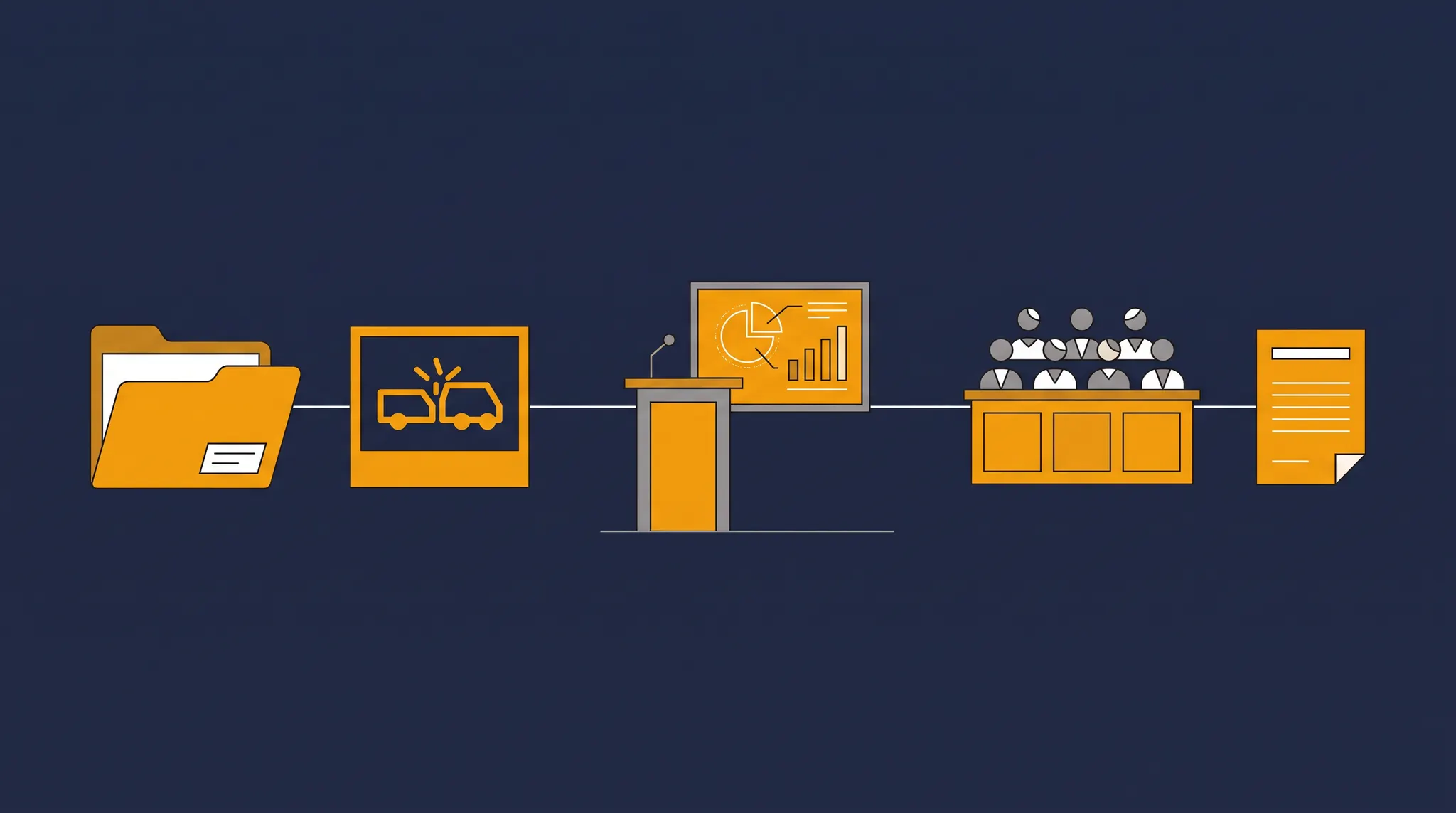
A car accident trial is the court process for turning disputed facts and legal issues into an enforceable decision. The parties do not simply hand the jury a claim file. They must present admissible testimony and exhibits, connect each item to a disputed question, address objections, propose instructions that state the governing law, and give the judge or jury a verdict form that can produce a usable decision.
The best preparation is therefore not a dramatic courtroom script. It is a controlled proof map that answers six questions: what must be decided, who can prove each fact, which exhibit supports the testimony, what objection may arise, what instruction governs the issue, and what finding the verdict form asks the jury to make.
Start the car accident trial with a disputed-issues map
A trial should focus on issues that remain genuinely disputed after pleadings, discovery, motions, and stipulations. Build one row for each issue rather than one folder for every document.
| Disputed issue | Proof question | Likely sources | Trial control |
|---|---|---|---|
| Collision responsibility | What conduct occurred, where, and in what sequence? | Drivers, neutral witnesses, scene photos, vehicle data, roadway evidence | Separate observation from reconstruction or opinion |
| Injury connection | Which diagnosed conditions are linked to the collision rather than another cause? | Treating records, imaging, clinicians, qualified experts, prior-condition evidence | Match the opinion to its stated basis and limits |
| Treatment and prognosis | What care occurred, why, and what remains uncertain? | Medical records, bills, providers, future-care evidence | Distinguish completed care from proposed or conditional care |
| Work and economic loss | What work was missed or changed, and how was the amount calculated? | Employer records, tax or pay documents, calendars, vocational or economic evidence | Make each calculation reproducible from source records |
| Daily-life impact | What activities changed, for how long, and with what recovery pattern? | Plaintiff testimony, contemporaneous messages, calendars, family or coworker observations | Use specific tasks rather than broad labels |
This map should connect to the car accident lawsuit process, but it serves a different purpose. The process guide explains the stages of litigation. The trial map identifies the exact proof needed for the questions that survive to trial.
Convert discovery material into admissible trial proof
Discovery collects information. Trial determines which parts can be presented as evidence. A medical record, repair estimate, photograph, data download, recorded statement, deposition excerpt, demonstrative, or expert report may still require a witness, stipulation, certification, foundation, or ruling before the factfinder can consider it.
Use an exhibit control table:
| Exhibit control field | What to verify |
|---|---|
| Source | Who created, captured, maintained, or received the item? |
| Completeness | Is this the complete file, page range, image set, or data export? |
| Date and version | Is the exhibit tied to the correct event and preserved in its original form? |
| Disclosure | Was it produced and identified by the applicable deadline? |
| Foundation | Which witness or permitted method establishes what the item is? |
| Purpose | Which disputed issue does it help prove or explain? |
| Objection risk | Are relevance, hearsay, authentication, completeness, unfair-prejudice, or expert-foundation issues expected? |
| Display plan | Can the court, witness, jury, reporter, and opposing counsel see the admitted material clearly? |
Do not assume that a document will be admitted because it was used at a deposition. The car accident deposition guide explains how sworn testimony is developed and corrected. Trial use depends on the evidence rules, procedural rules, pretrial order, rulings, and the purpose for which the material is offered.
Prepare witnesses by source, role, and limits
A witness plan should state what each person personally knows and what the person is qualified to explain. It should also state what the witness cannot establish.
- A driver may describe personal observations but may not have a reliable view of every vehicle movement.
- A neutral witness may describe position, signal phase, sound, or movement while lacking medical knowledge.
- A treating provider may explain care and clinical findings within the provider’s role and disclosed opinions.
- A records custodian may establish how records are created or maintained without interpreting the medical meaning.
- A qualified expert may offer an opinion within the disclosed specialty, methods, source data, assumptions, and limits.
- A family member or coworker may describe observed function without diagnosing an injury or calculating unsupported losses.
Create a one-page witness sheet with the witness’s role, firsthand facts, source documents, anticipated exhibits, prior statements, necessary opinion foundation, likely cross-examination subjects, and any language or accessibility needs.
The car accident expert witness guide provides a separate method for testing an expert’s qualifications, data, assumptions, methods, and opinion boundaries.
Build a chronology that can survive cross-examination
The trial chronology should not hide inconvenient events. It should identify them, connect them to source records, and explain which facts are agreed, disputed, or unknown.
Include:
- collision time, place, roadway controls, weather, visibility, and vehicle positions;
- first symptoms, scene statements, emergency evaluation, and transportation;
- each treatment event, test, referral, restriction, interruption, and reason documented;
- earlier or later incidents involving the same body region;
- work absence, modified duty, benefit use, and return-to-work changes;
- important insurer, provider, employer, or witness communications; and
- the date and source for each calculation of claimed loss.
Label estimates as estimates. If two records conflict, do not silently select the favorable version. Put both in the chronology, identify the source of the difference, and decide whether a witness, correction, stipulation, or ruling is needed.
Understand the Nevada trial sequence without assuming every courtroom is identical
Nevada civil procedure supplies a framework, while the assigned judge’s orders and department practices control many practical details. Nevada Revised Statutes Chapter 16 addresses civil jury trials, including the general order of proceedings, jury instructions, and materials the jury may take into deliberations. Nevada Rule of Civil Procedure 51 addresses requests for jury instructions, objections, preservation of claimed error, and delivery of final instructions.
A jury trial commonly includes:
- preliminary rulings and courtroom administration;
- jury selection and challenges;
- preliminary instructions;
- opening statements;
- the plaintiff’s witnesses and admitted exhibits;
- the defense presentation;
- any permitted rebuttal;
- final instructions;
- closing arguments;
- deliberation and questions from the jury; and
- verdict, polling when requested and permitted, and discharge.
The judge may change the order for a case-specific reason. A bench trial also differs because the judge serves as the factfinder. Department procedures may set separate requirements for exhibit binders, electronic media, witness scheduling, deposition designations, jury notebooks, proposed instructions, and verdict forms. Counsel should use the current order and the assigned department’s instructions, not a generic checklist alone.
Treat jury instructions and the verdict form as part of the proof plan
Jury instructions tell the jury the legal standards it must apply. The verdict form records the findings needed for judgment. These are not end-of-trial formatting tasks.
For each proposed instruction or verdict question, ask:
- Which pleaded claim, defense, or damages category does it address?
- What evidence supports giving the instruction?
- Is the wording drawn from controlling authority or an approved instruction?
- Are disputed terms defined consistently across the instructions and verdict form?
- Does the verdict form ask for every required finding without combining separate issues confusingly?
- Does the evidence map contain a witness and admitted exhibit path for each requested finding?
NRCP 51 requires parties to make instruction objections on the record with distinct grounds. Missing the proper time or basis for an objection can affect later review. Those decisions require counsel familiar with the actual record.
Present numbers through a source-linked damages ledger
A damages request should be traceable rather than announced as a single total. Use separate lines for categories such as medical charges, amounts paid or adjusted when legally relevant, lost earnings, property loss, out-of-pocket expense, future care, future earning effects, and noneconomic harm. The categories and admissible measures depend on the case and governing law.
For every number, record:
- source document and page;
- service or loss date;
- who calculated it;
- formula and assumptions;
- whether the amount is historical, projected, disputed, contingent, or updated;
- which witness can explain it; and
- which exhibit must be admitted for the calculation to work.
Do not double-count overlapping categories. Do not turn a treating estimate, benefit statement, billed charge, repair quote, or economic projection into a guaranteed recovery figure.
Use a daily trial control sheet
A live trial creates new rulings and deadlines. Maintain a short daily sheet rather than relying on scattered notes.
| Control | Same-day entry |
|---|---|
| Rulings | Issue, ruling, limiting condition, and record reference |
| Admitted exhibits | Exhibit number, admitted purpose, redactions, and publication status |
| Witness record | Called, completed, held open, excluded, or subject to recall |
| Offers of proof | Excluded evidence, stated purpose, foundation, and ruling |
| Instruction changes | Proposed, modified, withdrawn, refused, or given |
| Follow-up | Curative instruction, record supplement, schedule change, research, or motion deadline |
Use the court reporter’s record, filed papers, signed orders, and admitted exhibit list as the official sources. A private trial note helps organize work but does not replace the record.
Audit the verdict and post-trial calendar immediately
After the verdict, compare the verdict form with the instructions, claims, defenses, stipulated facts, and judgment requested. Confirm that every necessary question was answered and that totals, percentages, names, dates, and party designations are internally consistent.
Then calendar the next steps that may apply:
- entry and service of judgment;
- recoverable costs or authorized fee requests;
- post-trial motions;
- stays or security;
- appeal notices and related deadlines;
- interest calculations;
- insurer funding or judgment collection;
- liens, reimbursement claims, trust-account processing, and net distribution; and
- satisfaction or release of judgment.
Do not assume a verdict means immediate payment. Do not sign a post-verdict release, assignment, satisfaction, or distribution statement without reviewing its scope and the governing deadlines.
If your Nevada car accident case may be heading to trial, start the free 60-second case evaluation so the disputed issues, witnesses, exhibits, deadlines, and review needs can be assessed together.
This article provides general information, not legal advice. Trial sequence, admissibility, witnesses, jury instructions, verdict forms, damages, objections, motions, appeal rights, deadlines, and payment procedures depend on the court, judge, rules, orders, evidence, and facts. Nevada-specific trial procedure requires review by a licensed Nevada attorney.
Frequently Asked Questions
What happens at a car accident trial? +
The court resolves preliminary issues, selects a jury when the case is jury-tried, hears opening statements, receives witness testimony and admitted exhibits, instructs the jury on the governing law, allows closing arguments, and receives a verdict. The exact sequence and timing depend on the court, judge, pretrial orders, and issues that remain disputed.
Do I have to testify at my car accident trial? +
Many injured plaintiffs testify because their observations, symptoms, treatment history, work limits, and daily-life changes are part of the case. Whether a person will testify and how testimony should be prepared are case-specific decisions for counsel. Preparation should improve accuracy, not produce memorized answers.
Can every document or photo be shown to the jury? +
No. A proposed exhibit is not evidence merely because a party possesses it. The court may require a foundation, authentication, relevance, compliance with disclosure duties, and satisfaction of other evidence rules before an item is admitted. Pretrial orders and stipulations may resolve some exhibit issues in advance.
What happens after a car accident trial verdict? +
The court enters judgment and the parties evaluate any authorized post-trial motions, costs, interest, stay, appeal, payment, lien or reimbursement issues, and satisfaction of judgment. A verdict does not by itself explain every deadline or distribution step, so counsel should review the judgment and calendar immediately.
Injured in a Las Vegas accident?
Find out what your case is worth in under 60 seconds. Free, confidential, no obligation — and no fee unless we win.
Check My Case in 60 Seconds