Car Seat Replacement After Accident Insurance Guide
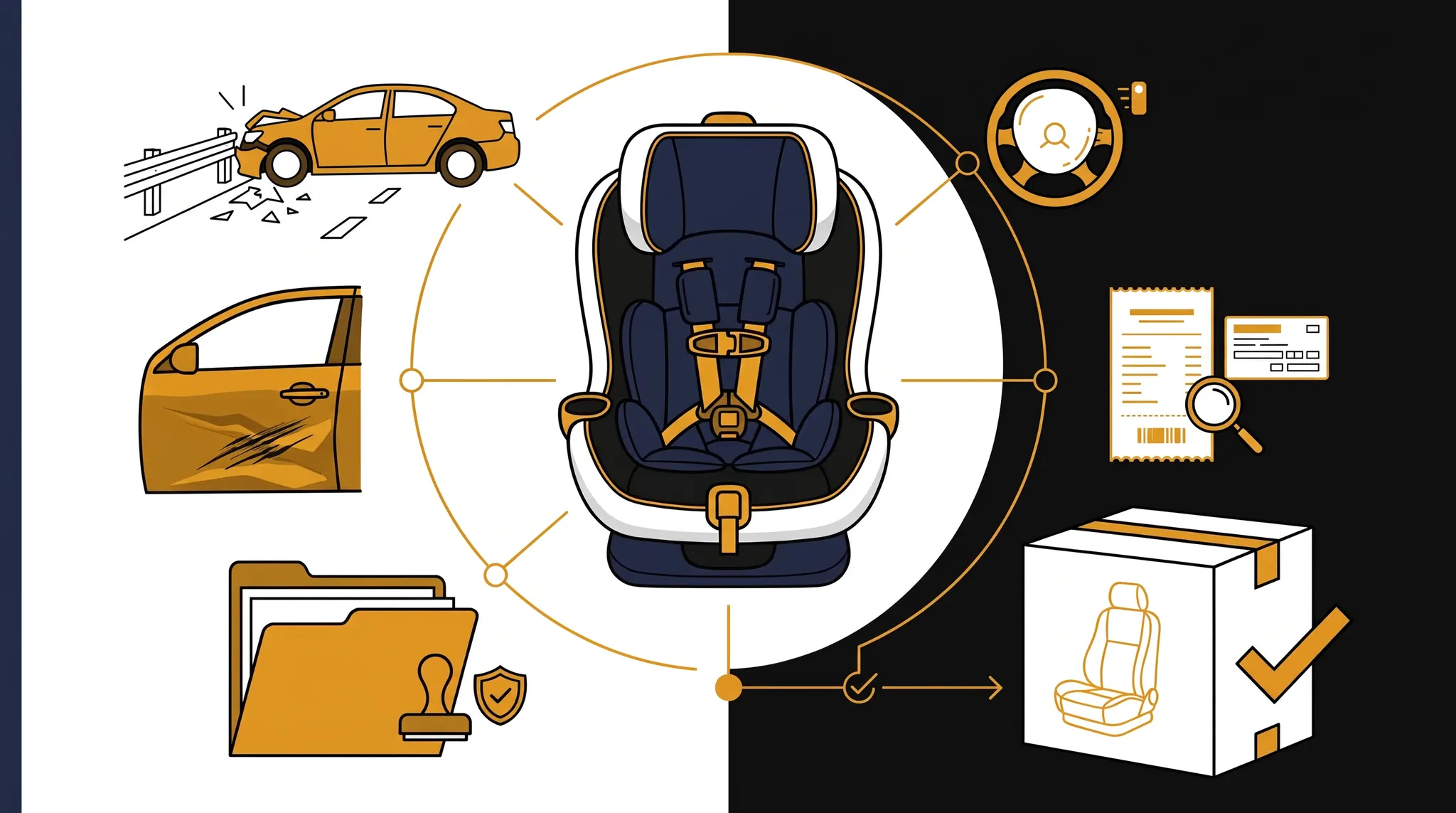
Car seat replacement after accident insurance coverage is not automatic, but a well-documented request is easier to evaluate. First decide whether the seat should remain in use under the seat manufacturer’s instructions and federal safety guidance. Then give the insurer a compact evidence packet showing the crash, the exact seat, the replacement basis, and the actual replacement cost.
This guide focuses on the child-restraint reimbursement file. It does not assume that every crash requires replacement or that every policy pays the expense.
Start with safety before asking who pays
Do not let the reimbursement question delay the safety decision. The National Highway Traffic Safety Administration recommends replacing car seats after a moderate or severe crash. NHTSA says a seat does not automatically need replacement after a minor crash only when all five conditions are true:
- The vehicle could be driven away from the crash.
- The door nearest the car seat was not damaged.
- No vehicle occupant was injured.
- The air bags did not deploy.
- The car seat has no visible damage.
These criteria do not override the seat manufacturer’s instructions. The American Academy of Pediatrics also advises checking the manufacturer because some manufacturers recommend replacement after any crash. If the manual requires replacement, save that page or obtain written guidance from the manufacturer.
Do not rely only on whether the seat looks normal. Stress or damage may not be obvious, and a claims adjuster does not decide whether a child restraint is safe for continued use.
Build a one-page car seat replacement claim sheet
Create one record for each child restraint in the vehicle. Do not group several seats into a vague line item. Record:
- manufacturer, model name, model number, and date of manufacture;
- serial number or other identifying label, if present;
- where the seat was installed and which vehicle door was nearest;
- whether a child occupied the seat during the collision;
- crash date, claim number, insurer, and adjuster;
- whether the vehicle was drivable, anyone was injured, and any air bag deployed;
- visible seat, base, harness, buckle, shell, or attachment damage;
- the manufacturer’s post-crash instruction; and
- original purchase price, replacement model, and actual replacement cost.
Photograph the entire seat, base, harness, installation location, surrounding interior, nearest door, and every model or manufacture label. Also photograph the vehicle damage and air-bag status. Keep the original files with their dates.
For the wider vehicle file, use our car accident property damage claim checklist. Keep the car-seat request as a distinct subfile so it does not disappear inside the repair estimate.
Match the evidence to the replacement reason
A strong request connects each conclusion to a record. Use a four-part replacement basis:
| Question | Best supporting record | Why it matters |
|---|---|---|
| Which seat was involved? | Model label, manufacture date, serial label, full-seat photos | Identifies the exact restraint rather than a generic product |
| What happened in the crash? | Scene photos, vehicle damage, nearest-door photo, air-bag status, injury record | Tests the crash against the safety criteria |
| Why should this seat be replaced? | Manual page, manufacturer email, NHTSA guidance | Shows the safety basis for replacement |
| What amount is requested? | Original receipt if available, comparable model, replacement receipt | Documents the actual expense without guessing |
If the original model is discontinued, ask the manufacturer which current model is comparable. Explain differences in seat type, child height or weight limits, required base, and essential functions. Avoid turning the request into an upgrade list. The goal is a safe, comparable replacement supported by records.
Ask the insurer for written submission rules
Call or write the adjuster promptly and ask:
- Which coverage or claim category will evaluate the child restraint?
- Is advance approval required before purchase?
- Will the insurer accept the manufacturer’s instruction as the replacement basis?
- Is an original receipt required, or will label photos and a current comparable price work?
- Must the damaged seat be retained for inspection?
- Does the insurer require a photo of disposal or destruction?
- Will payment go to the claimant, retailer, or another recipient?
- What written explanation will be provided if any amount is reduced or denied?
Confirm the answer in writing. A portal upload without a document list can leave the claim incomplete even when every item was sent.
Insurance handling differs by policy, responsible party, and claim posture. A first-party property-damage request may follow different procedures from a liability request against another driver’s insurer. The claim number alone does not establish that the expense is covered.
Submit a compact reimbursement packet
Put the documents in a clear order:
- Cover note: claim number, crash date, vehicle, claimant, and amount requested.
- Seat identification: label photos, seat type, installation location, and occupied status.
- Crash evidence: vehicle damage, nearest door, air bags, injuries, and drivability.
- Safety basis: relevant manufacturer instruction and NHTSA guidance.
- Cost proof: original receipt if available, comparable model explanation, and replacement receipt.
- Retention status: where the crashed seat is stored and whether inspection is available.
- Payment request: payee, mailing or electronic-payment details requested by the insurer, and requested response date.
Use filenames that an adjuster can understand, such as 01-seat-model-label.jpg and 05-replacement-receipt.pdf. Keep a copy of the upload confirmation or email.
Do not create a disposal problem
A crashed seat can be both a safety item and claim evidence. Before disposal, ask whether the insurer wants to inspect or retain it. Photograph the complete seat and labels first. If the insurer gives disposal instructions, save them and document compliance.
At the same time, do not place a seat back into service merely to preserve evidence. Follow the manufacturer and NHTSA safety guidance. Store a seat that should not be used where it cannot be mistaken for an available child restraint.
If disposal is authorized, prevent unsafe reuse according to local waste rules and manufacturer guidance. Do not donate or resell a seat that should no longer be used.
Audit the payment against the request
When the insurer responds, compare the decision line by line:
| Claim item | Requested | Allowed | Reason for difference | Proof still needed |
|---|---|---|---|---|
| Replacement seat | ||||
| Required base | ||||
| Sales tax | ||||
| Shipping or pickup | ||||
| Other required part |
Check whether the insurer priced the correct seat type and included required components. If an amount is denied, request the policy, coverage, valuation, or factual reason in writing. Our car accident claim denial guide explains how to organize that response without losing the original records.
Do not sign a broad release merely to receive a small property payment without reading its actual scope. Confirm whether it addresses only the listed child-restraint expense or reaches other property or injury claims.
Use this final car seat claim checklist
Before closing the file, confirm that:
- the safety decision follows both NHTSA guidance and the manufacturer’s instructions;
- every seat has its own identity, crash, and cost records;
- the insurer received the complete packet;
- inspection and disposal instructions are documented;
- the replacement receipt matches the requested amount;
- any reduction or denial has a written reason; and
- the payment and release cover only what you understand them to cover.
If a child passenger was injured or the insurer is disputing crash-related expenses, start the 60-second case evaluation and bring the seat labels, manufacturer instructions, photos, receipts, claim correspondence, and proposed release.
This article provides general information, not legal advice. Safety decisions, insurance coverage, reimbursement, evidence requirements, and legal rights depend on the seat manufacturer’s instructions, policy terms, current guidance, jurisdiction, and specific facts.
Frequently Asked Questions
Does insurance cover car seat replacement after an accident? +
It may. Reimbursement depends on the applicable policy or liability claim, the crash facts, the seat manufacturer's instructions, and the documentation supplied. Ask the adjuster for a written coverage position and submission requirements.
Does a car seat need replacement after every crash? +
Not under NHTSA's general guidance. NHTSA recommends replacement after moderate or severe crashes. A seat involved in a minor crash may not automatically require replacement only if all five NHTSA minor-crash criteria are met and the manufacturer permits continued use.
What proof should I send for a car seat replacement claim? +
Send crash details, photos of the vehicle and seat, the seat's model and manufacture labels, the manual or manufacturer guidance, the original receipt if available, the replacement receipt, and the insurer's claim number and instructions.
Should I throw away the crashed car seat before the insurer responds? +
Usually it is better to photograph the seat and labels, preserve the manual and purchase records, and ask the insurer whether inspection, retention, or disposal proof is required before discarding it. Do not keep using a seat that safety guidance says should be replaced.
Injured in a Las Vegas accident?
Find out what your case is worth in under 60 seconds. Free, confidential, no obligation — and no fee unless we win.
Check My Case in 60 Seconds