Diminished Value Claim for a Car Accident: Proof Guide
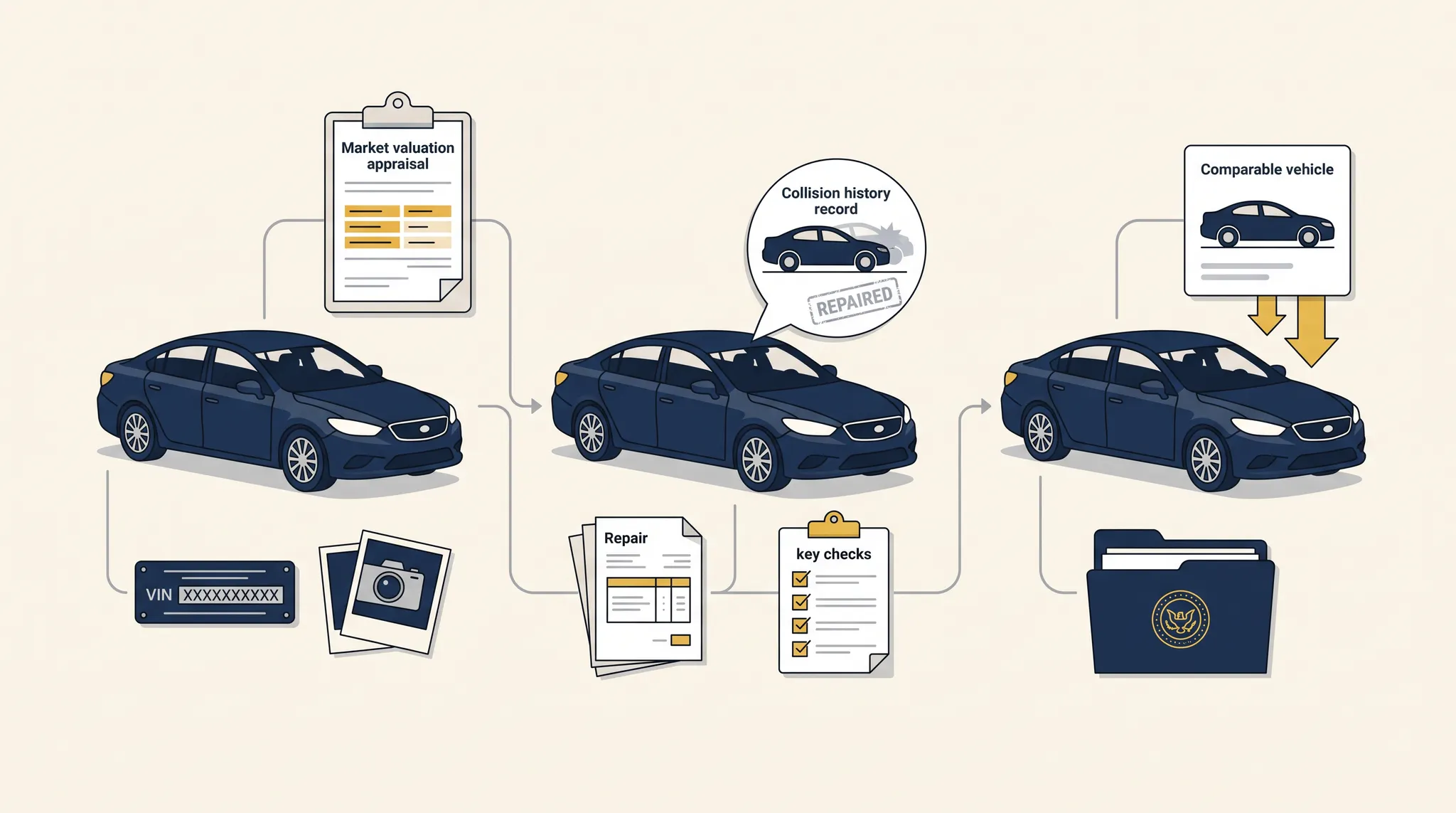
A diminished value claim for a car accident seeks the difference between a vehicle’s market value before the crash and its value after proper repairs, when collision history or remaining repair-related concerns still reduce what informed buyers would pay. The repair invoice alone does not establish that difference. Build a vehicle-specific proof file that connects condition, damage, repairs, history, and market evidence.
This guide focuses on a repaired vehicle. Total-loss valuation, rental expenses, and bodily injury are separate issues. Whether a diminished value claim is available depends on who caused the crash, which coverage applies, policy language, state law, ownership, releases, and the evidence.
Start with the right diminished value question
Do not begin with “What percentage should the insurer pay?” Begin with two market questions:
- What would this specific vehicle likely have sold for immediately before the collision?
- What would the same vehicle likely sell for after the completed repairs and disclosure of its collision history?
The claimed loss is the supported difference between those two values. A generic formula may help screen whether further work is worthwhile, but it can miss vehicle-specific factors such as trim, mileage, prior damage, repair scope, structural measurements, safety-system calibrations, local supply, and buyer reactions.
Keep this valuation question separate from the broader car accident property damage claim checklist. That file tracks repairs, towing, transportation, payments, and releases. A diminished value file narrows in on post-repair market loss.
Confirm the claim path before paying for an appraisal
Identify the claim path in writing:
| Control question | What to verify |
|---|---|
| Responsibility | Has the other driver or another party accepted responsibility, or is fault still disputed? |
| Coverage | Is the request being made under another party’s property damage liability coverage, your own policy, or another source? |
| Ownership | Who owned or leased the vehicle on the collision date, and who holds the claimed loss? |
| Repair status | Are repairs complete, and are supplements, scans, calibrations, or quality concerns still open? |
| Release status | Has anyone signed a release or accepted language that may resolve additional property rights? |
| Limits and competing damage | Is available property coverage also being used for repairs, towing, rental, or damage to other property? |
Do not assume your own collision coverage and another driver’s liability coverage provide the same rights. Policy language and applicable law can treat first-party and third-party requests differently. Ask the carrier to identify its position and the policy or legal basis in writing.
Build a six-document diminished value packet
A clear packet lets a reviewer trace every conclusion without searching through scattered emails.
1. Vehicle identity sheet
Record the VIN, year, make, model, trim, drivetrain, mileage on the loss date, factory options, title status, ownership, service history, and prior damage. Include the window sticker or a VIN-based equipment report when available.
2. Pre-crash condition record
Use dated photographs, maintenance invoices, detailing records, tire and major-component receipts, prior listings, inspection reports, and honest disclosure of earlier damage. A clean baseline is more persuasive when it also identifies weaknesses rather than presenting the vehicle as flawless.
3. Collision and repair record
Preserve scene and damage photos, the initial estimate, every supplement, parts invoices, final repair invoice, structural measurements, alignment records, diagnostic scans, calibration records, and repair warranty. Keep documents in order so the file shows what changed after teardown.
4. Post-repair inspection
Photograph the repaired vehicle in consistent lighting. Record panel fit, paint match, warning lights, handling concerns, scan results, and any qualified inspection findings. Do not label a condition as defective without technical support. If the repair facility corrects an issue, preserve both the original concern and the correction record.
5. Market comparison file
Collect comparable vehicles that match the same model year, trim, drivetrain, mileage range, options, condition, and geographic market as closely as possible. Save the full dated listing, seller, location, VIN when shown, asking price, and material differences.
6. Valuation explanation
Show the pre-crash value, post-repair value, each source used, every adjustment, and the final difference. If an appraiser is involved, the report should explain the inspection, market area, comparable selection, collision-history effect, assumptions, and calculation.
Compare vehicles with adjustments, not screenshots alone
A listing price is not automatically a sale price, and a different trim or mileage can distort the comparison. Use a table that makes the reasoning visible:
| Comparable | Match strengths | Material differences | Adjustment support | Weight |
|---|---|---|---|---|
| Vehicle A | Same year, trim, drivetrain | 8,000 fewer miles | Mileage source and local listings | High |
| Vehicle B | Similar mileage and options | Different model year | Year-to-year market comparison | Medium |
| Vehicle C | Same year and mileage | Prior collision disclosed | Dealer statement or history report | High for post-repair value |
Separate asking prices, trade-in indications, purchase offers, and completed transactions. They answer different questions. A dealer statement is stronger when it identifies the vehicle, states whether the collision history was considered, gives a date, and explains the effect on the offered price.
Test whether the appraisal is reproducible
A useful diminished value appraisal should let another reviewer follow the analysis. Check whether it includes:
- the correct VIN, trim, mileage, options, and loss date;
- photographs and the repair documents reviewed;
- the date and scope of any physical inspection;
- the geographic market and valuation date;
- each comparable and why it was selected;
- adjustments for mileage, condition, equipment, and history;
- a distinction between unrepaired damage, repair-quality issues, and collision-history stigma;
- the pre-crash and post-repair values; and
- the appraiser’s qualifications and any important limitations.
Be cautious with reports that apply a hidden formula, cap, or multiplier without connecting it to the actual market for the vehicle. Also question a report that assumes every repaired vehicle loses the same percentage. The evidence should explain this vehicle’s market loss.
Write a demand that can be audited
Put the conclusion first. Identify the collision date, claim number, vehicle, owner, responsibility position, repair completion date, amount requested, and response deadline. Then attach an indexed packet and explain the calculation in a few steps.
A practical index may include:
- vehicle identity and ownership;
- pre-crash condition records;
- collision photos and estimates;
- final repair and calibration records;
- vehicle-history report;
- post-repair inspection;
- comparable vehicles or purchase offers;
- appraisal and calculation; and
- prior insurer communications.
Ask the carrier to identify any disputed fact, comparable, adjustment, or coverage position in writing. If it uses its own valuation, request the report and the data behind the calculation. Keep a dated response log rather than repeating the same demand without addressing the reason for disagreement. If the carrier rejects the request, use the car accident claim denial guide to separate the coverage, responsibility, valuation, and missing-evidence issues.
Avoid five common diminished value claim mistakes
Claiming before the repair file is stable
An early estimate may change after teardown, supplements, scanning, alignment, or calibration. A final post-repair valuation is difficult to support while the repair scope remains open.
Using only an online calculator
A calculator cannot inspect repairs, confirm collision history, select truly comparable vehicles, or measure the local market. Treat it as an initial screen, not the complete evidence.
Ignoring prior damage or title history
Prior collisions, unrepaired damage, branded title history, and heavy wear can affect the pre-crash baseline. Disclose and separate them. An omission can undermine the entire valuation.
Mixing repair defects with market loss
A poor repair may require correction. Inherent market loss may remain even after proper repairs because informed buyers react to collision history. Identify which issue each dollar represents so the demand does not double count.
Signing before checking the release
A property check or settlement document may include release language. Confirm which vehicle, parties, claim categories, and rights it resolves before accepting or signing. The car accident settlement check guide explains why the payment path and release scope should reconcile.
Use a final four-part proof test
Before sending the claim, ask:
- Baseline: Can the file prove the vehicle’s pre-crash identity, condition, and market value?
- Repair: Does it contain the complete damage and repair history, including supplements and technical records?
- Market: Do the post-repair comparisons reflect similar vehicles and disclose meaningful differences?
- Math: Can a reviewer reproduce every adjustment and the requested amount?
If the answer to any one is no, strengthen that part before arguing over the final number.
If a property damage dispute or broad release is affecting an injury claim, start the 60-second case evaluation and bring the repair file, appraisal, comparable vehicles, insurer response, and proposed release.
This article provides general information, not legal advice. Diminished value rights, coverage, proof requirements, deadlines, releases, and recoverable amounts depend on current law, policy language, responsibility, ownership, the vehicle, and the specific facts.
Frequently Asked Questions
What is a diminished value claim after a car accident? +
It is a request for compensation for a proven reduction in a vehicle's market value after collision repairs. The claim is separate from the repair bill and depends on responsibility, coverage, the vehicle, the repairs, and evidence of the post-repair market loss.
How do I prove diminished value? +
Document the vehicle's pre-crash identity and condition, the complete repair history, its post-repair condition, and comparable market evidence. A qualified appraisal may help when it explains its sources, adjustments, inspection, and calculation rather than stating only a final number.
Can I use a formula to calculate diminished value? +
A formula can be a screening tool, but it may not prove the actual market loss for a specific vehicle. A stronger claim connects vehicle-specific facts, completed repairs, collision history, comparable vehicles, dealer or buyer evidence, and a transparent valuation method.
Should I sign a property damage release before making the claim? +
Read the full release first. A release may identify the vehicle, collision, parties, claim categories, or rights being resolved more broadly than expected. Ask for clarification and legal advice before signing if the scope is unclear.
Injured in a Las Vegas accident?
Find out what your case is worth in under 60 seconds. Free, confidential, no obligation — and no fee unless we win.
Check My Case in 60 Seconds