Car Accident Event Data Recorder: What the Black Box Shows
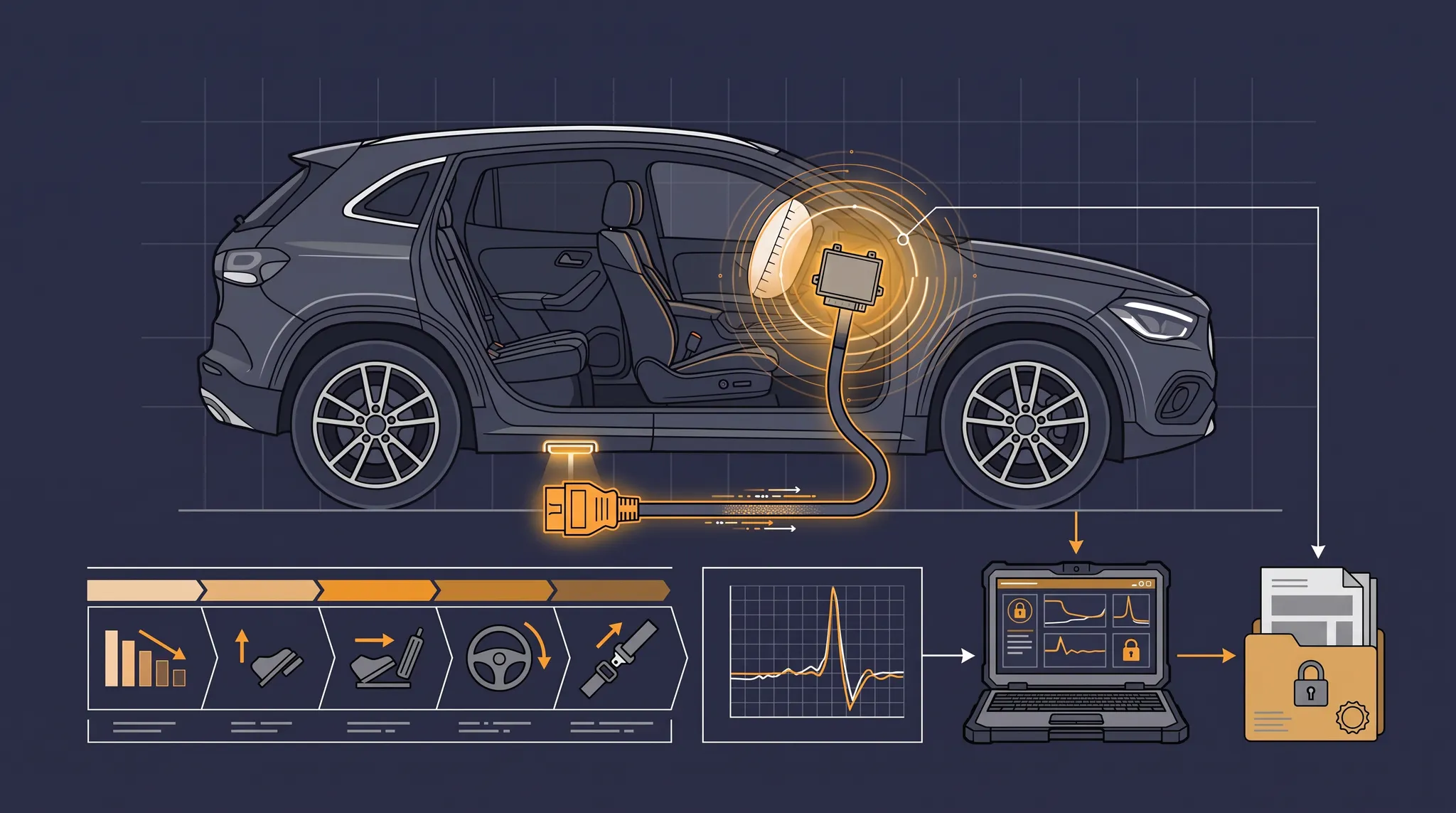
A car accident event data recorder, often called a vehicle black box, may preserve a few seconds of technical vehicle and occupant information before, during, and after a qualifying crash. Depending on the vehicle, it may help evaluate indicated speed, braking, accelerator input, change in velocity, safety-belt status, airbag deployment, and event timing. It does not record a continuous trip, cabin conversation, or crash video.
The useful question is not simply whether a vehicle has an EDR. It is whether the correct vehicle recorded the correct event, whether the data remains available, whether a qualified download can retrieve it without changing the evidence, and how the reported fields fit the rest of the crash record.
Confirm that the vehicle and event support an EDR download
Start with the exact year, make, model, vehicle identification number, restraint system, and crash date. Similar-looking vehicles can use different modules, software, trigger rules, or supported fields.
Check four points before relying on a download:
| Control point | What to verify | Why it matters |
|---|---|---|
| Equipment | Whether the vehicle is equipped with an EDR and where the function resides | Not every vehicle or module has the same capability |
| Coverage | Whether a compatible retrieval tool and current software support the vehicle | A connector fitting does not prove complete support |
| Trigger | Whether the collision met the system’s recording condition | A minor or unusual event may not create a retrievable record |
| Event match | Whether the stored event corresponds to the crash being investigated | Prior or later events can create confusion |
NHTSA defines an EDR as a device or function that records technical vehicle and occupant information for a brief period, measured in seconds rather than minutes. The owner’s manual may disclose the equipment and its basic purpose. A qualified reviewer should still confirm the actual vehicle configuration and download coverage.
Understand what the car accident black box may record
Federal requirements in 49 CFR Part 563 standardize specified data for vehicles equipped with covered EDRs. Required fields can include longitudinal change in velocity, indicated vehicle speed, throttle or accelerator position, service-brake status, ignition cycles, driver safety-belt status, airbag warning status, airbag deployment timing, multi-event information, and whether the file is complete. Other fields, such as steering input, engine speed, stability-control activity, or lateral change in velocity, may be reported under specified conditions when the vehicle records them.
Treat every field as a measured or reported signal with a defined interval, resolution, and limit. “Speed” may mean indicated vehicle speed sampled at stated points before time zero. “Brake on” is not the same as measured braking force. Delta-V describes a recorded change in velocity during the event, not automatically the vehicle’s travel speed before impact.
| Data group | Question it may help test | What it does not establish alone |
|---|---|---|
| Pre-crash signals | Was speed, throttle, braking, steering, or stability control reported before time zero? | Why the driver acted or whether the signal is legally negligent |
| Crash pulse | What longitudinal or lateral change in velocity did the supported system record? | Injury diagnosis or a complete force history for every occupant |
| Restraints | What belt or airbag status did the module report? | Proper fit, occupant position, or medical causation |
| Event sequence | Was more than one event stored, and how were they timed? | The full roadway sequence without outside evidence |
Preserve the vehicle before repair, sale, or salvage
An EDR is not a cloud account that can always be downloaded later. The data is tied to a vehicle and module that may be repaired, powered, replaced, sold, moved, or destroyed. Federal rules protect specified airbag-deployment event memory from later overwriting, while some non-deployment event buffers may be overwritten or may not retain a later event when memory is occupied. The system and event must be evaluated rather than assuming permanence.
Record the vehicle’s location, custodian, condition, key availability, battery status, repair plan, salvage status, and any scheduled inspection. Do not disconnect modules, probe wiring, cycle ignition, repair restraints, clear diagnostic codes, or experiment with download hardware without a qualified plan. Those actions can affect the vehicle, create new records, or complicate the evidence history.
A written preservation request may be appropriate when another person, insurer, tow yard, repair facility, rental company, employer, or salvage facility controls the vehicle. Legal duties and the method for obtaining access depend on the parties, ownership, notice, pending dispute, and applicable procedure. The broader car accident reconstruction guide explains how the vehicle download fits with physical, photographic, and roadway evidence.
Follow Nevada’s event-recording-device access rule
NRS 484D.485 requires disclosure in the owner’s manual when a new vehicle sold or leased in Nevada is equipped with an event recording device. It generally states that someone other than the registered owner may not download or retrieve the recorded data unless a listed exception applies. The statute includes exceptions involving owner consent, a court order, specified safety research, vehicle diagnosis or service, and disclosed subscription services.
That rule does not answer every evidence question. A crash may involve a leased, rented, employer-owned, financed, shared, commercial, or salvaged vehicle. Possession of the vehicle is not automatically permission to retrieve its data. Before arranging access, confirm who owns the vehicle, who controls it, what consent or legal authority exists, who will perform the work, and what notice or inspection protocol is required.
Use a qualified, documented download process
A defensible download should let another reviewer identify the vehicle, tool, software, method, operator, source file, and report version.
- Photograph and identify the vehicle, VIN, module location, damage, dashboard, and relevant warning indicators.
- Record the vehicle condition and any steps needed to stabilize power or access the module.
- Confirm the compatible retrieval hardware, cables, adapters, and software version.
- Choose the least intrusive supported method, whether through the diagnostic connector or direct module imaging.
- Save the native download and generated report without editing either file.
- Create verified working copies and document every transfer.
- Record warnings, unsupported fields, incomplete files, failed attempts, and assumptions.
Federal rules require manufacturers of covered EDR-equipped vehicles to make a commercially available retrieval tool or method available. That does not mean every technician, scan tool, or repair reader can produce a complete forensic download.
Match the EDR report to independent crash evidence
The report becomes useful when its timeline is aligned with sources that do not depend on the module. Compare the recorded event with:
- scene and vehicle photographs;
- roadway marks, debris, geometry, and measurements;
- dash-cam, surveillance, traffic, or fleet video;
- police observations and attributed statements;
- witness viewing position and timing;
- damage, inspection, repair, towing, and salvage records; and
- verified vehicle specifications and system documentation.
A brake-status field may support evidence of a response, but it may not show brake pressure, tire-road friction, or whether the vehicle had enough distance to stop. Indicated speed may help test an account, but timing alignment and system limits still matter. The fault-determination guide shows how technical data is weighed with traffic duties and competing sources.
Audit the report before using it in a claim
Before drawing a conclusion, answer these questions:
- Is the VIN and vehicle configuration correct?
- Does the event timestamp or sequence match the collision?
- Is the file complete, and did the tool report warnings?
- Which fields are required, conditional, unsupported, invalid, or out of range?
- What does time zero mean for this vehicle and report?
- Are units, sampling intervals, accuracy, and resolution stated correctly?
- Does an apparent signal conflict with video, damage, roadway evidence, or another event?
- Has a qualified person separated recorded facts from interpretation?
Do not convert one field into a legal conclusion. Preserve the native materials, state the limits, and show how each interpretation was tested.
If a vehicle may contain time-sensitive crash data, start the free 60-second case evaluation before repair, sale, or salvage changes the evidence.
This article provides general information, not legal advice. EDR equipment, ownership, access, consent, preservation, downloads, admissibility, interpretation, and legal duties depend on the vehicle, event, parties, jurisdiction, current law, and facts. Nevada-specific issues require review by a licensed Nevada attorney.
Frequently Asked Questions
What does a car accident event data recorder show? +
Depending on the vehicle and recorded event, an EDR may report a brief time series for indicated speed, throttle or accelerator position, brake status, change in velocity, safety-belt status, airbag deployment, and certain other supported data. It is not a continuous video or complete driving history.
Does every car have a black box that records a crash? +
No. Equipment, supported data elements, trigger conditions, memory behavior, and retrieval coverage vary by vehicle, model year, system, and event. Confirm the owner's manual, vehicle identification, applicable coverage, and qualified-tool support before assuming data exists.
Can the insurance company download my car's EDR without permission in Nevada? +
Nevada law generally limits retrieval by someone other than the registered owner, subject to listed exceptions such as owner consent and a court order. The exact right to access, inspect, preserve, or compel data depends on ownership, possession, applicable exceptions, legal process, and the facts.
Can EDR data prove who caused a car accident? +
EDR data can help test speed, braking, acceleration, restraint, and crash-severity questions, but it rarely decides legal fault by itself. The download must be matched to the correct vehicle and event and compared with roadway evidence, video, damage, witnesses, traffic duties, and stated limitations.
Injured in a Las Vegas accident?
Find out what your case is worth in under 60 seconds. Free, confidential, no obligation — and no fee unless we win.
Check My Case in 60 Seconds