Car Accident Reconstruction: Evidence, Methods, and Limits
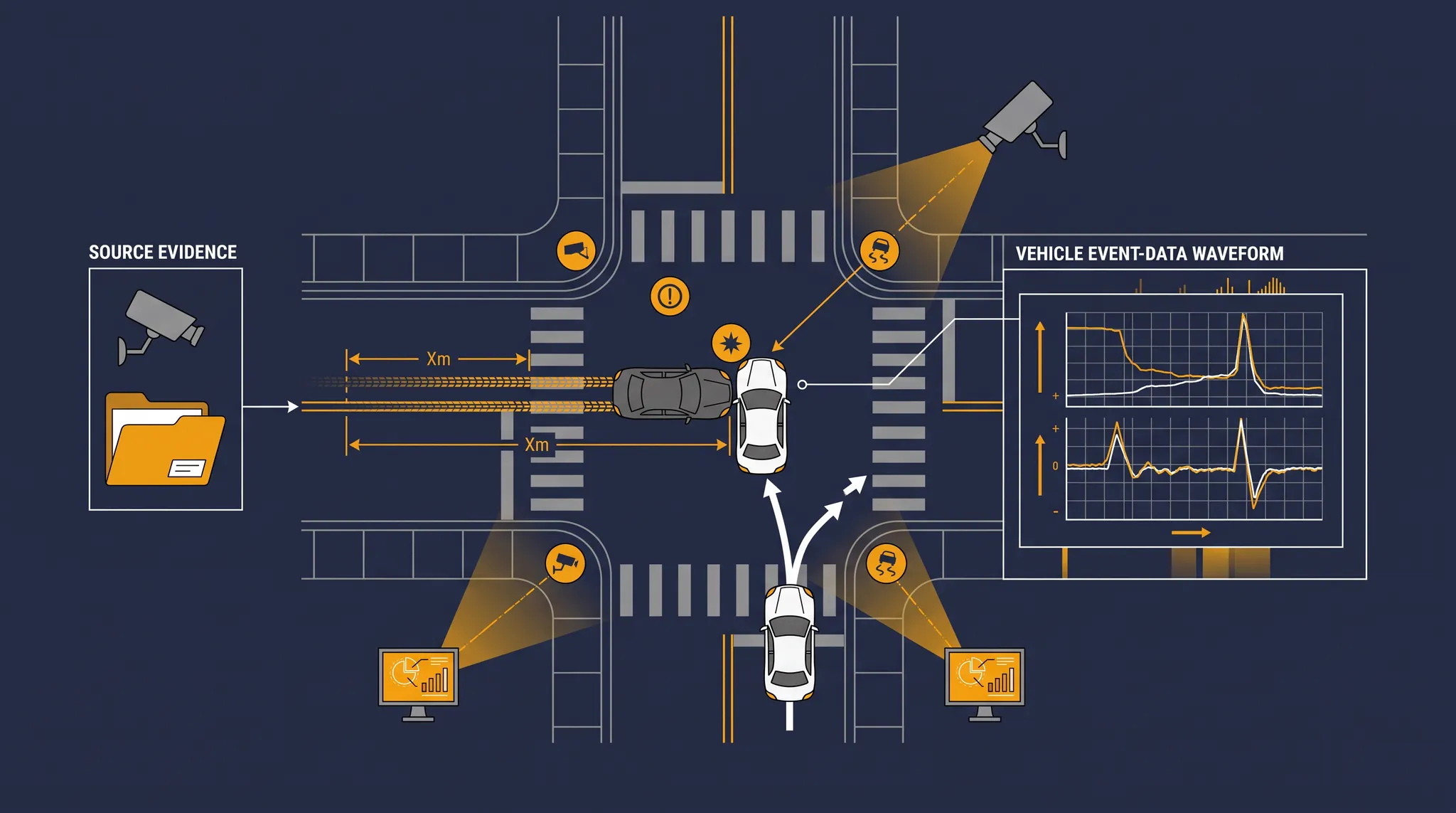
Car accident reconstruction is a technical method for testing how a crash may have happened by comparing a proposed sequence with physical, digital, photographic, and testimonial evidence. A reconstruction can estimate or explain vehicle movement, impact geometry, timing, speed ranges, braking, visibility, and other defined issues. It cannot repair missing evidence, determine medical causation outside the analyst’s field, or decide legal fault for the judge or jury.
The useful question is not, “Can an expert recreate the crash?” It is, “Which disputed fact can be tested, with which preserved evidence, by which repeatable method, and within what limits?”
Start car accident reconstruction with one disputed question
A reconstruction should begin with a narrow question. Starting with a desired answer invites confirmation bias and wastes time on calculations that do not affect the claim.
| Disputed question | Evidence that may matter | Caution |
|---|---|---|
| Where did the first impact occur? | Debris, fluid, gouges, vehicle damage, photographs, video, final positions | Final positions may change after secondary movement or towing |
| How were the vehicles moving? | Roadway geometry, tire marks, video timing, event data, damage alignment | Direction can be clearer than exact speed |
| Was there time or distance to react? | Sight lines, signal timing, lighting, perception-response assumptions, speeds | Avoidability depends on stated assumptions and reliable inputs |
| Does a driver’s account fit the scene? | Statements, witness views, video, measurements, vehicle data | Inconsistency does not automatically identify the correct version |
| Did a vehicle system or roadway feature matter? | Inspection, maintenance records, warnings, specifications, roadway plans | The right engineering specialty may be required |
This focus separates reconstruction from a general car accident expert witness review. An expert-witness plan asks who is qualified to address each technical issue. Reconstruction asks whether collision mechanics can be derived from the available crash evidence.
Preserve the evidence before it changes
Reconstruction quality is limited by the original record. Vehicles are repaired, sold, downloaded, or destroyed. Road marks fade. Intersection cameras and business surveillance systems may overwrite recordings. Mobile-device files lose metadata when they are forwarded or compressed.
Preservation may include:
- original scene photographs and videos with their native files and metadata;
- wide, medium, and close views showing road layout, controls, marks, debris, and sight lines;
- all sides of each vehicle, the passenger compartment, restraints, tires, lights, and damaged components;
- vehicle storage, repair, salvage, inspection, and ownership information;
- event data recorder availability and a qualified download plan;
- dash-cam, traffic-camera, doorbell, commercial-property, and nearby vehicle video;
- witness contact details and the witness’s actual viewing position;
- crash reports, diagrams, dispatch records, and supplemental materials; and
- roadway design, construction, signal, lighting, weather, and maintenance records when relevant.
NHTSA explains that an event data recorder may capture technical vehicle and occupant information for only seconds before, during, and after a crash. Depending on the vehicle, this can include pre-crash dynamics, driver inputs, crash signatures, and restraint status. EDR data is not a continuous trip video and should not be interpreted without confirming the vehicle, supported data elements, download method, and limitations. See the NHTSA event data recorder overview.
Our dash-cam evidence guide explains how to retain original video rather than relying on a clipped social-media copy.
Build a source-integrity ledger
Before calculating anything, record where every input came from and whether it has been verified.
| Source-control field | What to record |
|---|---|
| Item | Exact file, photograph, component, measurement, or record |
| Origin | Who created, collected, downloaded, maintained, or supplied it |
| Date and version | When it was created and whether a more complete version exists |
| Integrity | Original, copy, compressed export, edited image, screenshot, or transcription |
| Event match | How the item is tied to the correct vehicle, location, time, and collision |
| Measurement basis | Scale, reference point, device, calibration, and uncertainty |
| Limits | Missing views, altered scene, moved vehicles, unknown timing, or unsupported fields |
A diagram is not automatically a measurement. A repair photograph may document damage without showing the first contact point. A police report may record observations and statements while still leaving technical questions unresolved. Label each source by what it actually establishes.
Separate observation, assumption, and calculation
A reconstruction becomes easier to audit when every important input carries one of three labels:
- Observed: directly documented, measured, recorded, or inspected.
- Assumed: supplied for analysis but not independently established.
- Calculated: derived through a stated method from observed and assumed inputs.
For example, a video frame rate may be verified from the native file, a vehicle length may come from a manufacturer specification, a road grade may be measured, and a driver reaction time may be an assumed range. The final timing or speed range is calculated from those inputs.
If an assumption changes the result materially, show the sensitivity. A useful report explains what happens under a reasonable range rather than hiding uncertainty behind one precise number.
Test multiple collision sequences
Reconstruction should test plausible alternatives, not only the version supplied by the retaining party. A disciplined sequence review can include:
- pre-impact lane, heading, and movement;
- traffic controls and available sight lines;
- braking, steering, acceleration, or loss-of-control evidence;
- first contact and principal force direction;
- rotation, translation, secondary contact, and final positions; and
- whether each step agrees with damage, marks, video, data, and witness observations.
A sequence can be rejected because it conflicts with a verified source. It can remain possible without being proven. It can also be indeterminate because key inputs are missing. Those are different conclusions and should be stated separately.
Understand what reconstruction can and cannot conclude
A reconstruction may support conclusions such as a collision path, relative timing, impact orientation, a bounded speed estimate, line-of-sight conditions, or whether a proposed movement is physically consistent with the evidence.
It usually cannot, by itself:
- decide negligence or assign a legal percentage of fault;
- determine what a driver subjectively saw or intended;
- diagnose an injury or establish medical causation;
- guarantee one exact speed when the inputs support only a range;
- convert an incomplete dataset into certainty; or
- tell the fact-finder which witness is truthful.
The car accident fault determination guide explains the broader responsibility analysis, including traffic duties, credibility, and competing evidence. Reconstruction is one technical layer within that process.
Decide whether reconstruction is proportionate
Not every claim needs reconstruction. Use a short proportionality screen before authorizing inspections, downloads, modeling, or testimony.
| Question | A stronger reason to proceed | A weaker reason to proceed |
|---|---|---|
| Is the issue material? | The answer may change responsibility, causation analysis, or case value | The issue is interesting but does not affect an outcome |
| Is it disputed? | Parties or records give materially different sequences | The important sequence is admitted and well documented |
| Is source evidence available? | Original files, vehicles, measurements, and records can be preserved | Key sources are gone or cannot be matched to the event |
| Can a qualified analyst use a recognized method? | The method fits the issue and inputs | The opinion would depend mostly on unsupported assumptions |
| Will the result be usable? | It can guide evaluation, negotiation, discovery, or admissible testimony | It duplicates clear photographs or ordinary witness testimony |
| Is the cost justified? | The stakes and technical dispute support the expense | The likely answer would not change the claim strategy |
Early consultation may still be useful when the immediate need is preservation rather than a final opinion. A qualified analyst can identify which vehicle, video, roadway, and data sources may disappear while counsel evaluates whether a full reconstruction is justified.
Review the reconstruction as an auditable work product
A reconstruction report or presentation should allow another qualified person to understand the path from source evidence to conclusion. Check for:
- a precise assignment and issue statement;
- complete source and inspection lists;
- clear separation of facts, assumptions, measurements, and calculations;
- method descriptions, formulas, software versions, and validation information where relevant;
- diagrams that identify scale, orientation, source, and whether they are measured or illustrative;
- treatment of conflicting evidence and plausible alternatives;
- uncertainty, ranges, error sources, and excluded conclusions; and
- revisions when later discovery changes a material input.
Nevada law addresses expert qualifications and specialized testimony in NRS 50.275. Whether a particular reconstruction opinion is disclosed, admissible, or persuasive depends on the expert, methods, facts, procedural rules, court orders, and case record. Those issues require review by Nevada counsel.
If collision mechanics, speed, visibility, vehicle position, or avoidability are disputed, start the free 60-second case evaluation before vehicles, video, or roadway evidence changes.
This article provides general information, not legal advice. Evidence preservation, inspections, downloads, expert disclosures, admissibility, deadlines, costs, and reconstruction conclusions depend on the vehicles, sources, jurisdiction, court, orders, methods, and facts. Nevada-specific issues require review by a licensed Nevada attorney.
Frequently Asked Questions
What is car accident reconstruction? +
Car accident reconstruction is a technical analysis that uses physical, digital, photographic, and testimonial evidence to evaluate how a collision may have occurred. The analysis can address vehicle movement, impact location, timing, speed ranges, visibility, braking, and other defined questions, but its conclusions depend on the quality and completeness of the source evidence.
Does accident reconstruction prove who was legally at fault? +
Not by itself. Reconstruction may help explain collision mechanics and whether a proposed sequence fits the evidence. Legal responsibility also depends on traffic duties, witness credibility, admissible evidence, and the fact-finder's decisions. A reconstructionist should not replace the court's role with a legal conclusion.
What evidence does a reconstruction expert need? +
Useful sources may include scene and vehicle photographs, measurements, video, event data recorder downloads, repair and inspection records, roadway plans, traffic-signal information, weather and lighting records, witness accounts, and verified vehicle specifications. Not every case has every source.
When is accident reconstruction worth the cost? +
It may be proportionate when a material issue such as collision sequence, speed, visibility, vehicle position, or avoidability remains disputed and reliable source evidence exists. It may add little when the important facts are admitted, clearly recorded, or unsupported by enough data for a dependable analysis.
Injured in a Las Vegas accident?
Find out what your case is worth in under 60 seconds. Free, confidential, no obligation — and no fee unless we win.
Check My Case in 60 Seconds