Car Accident Repair Estimate: What to Check
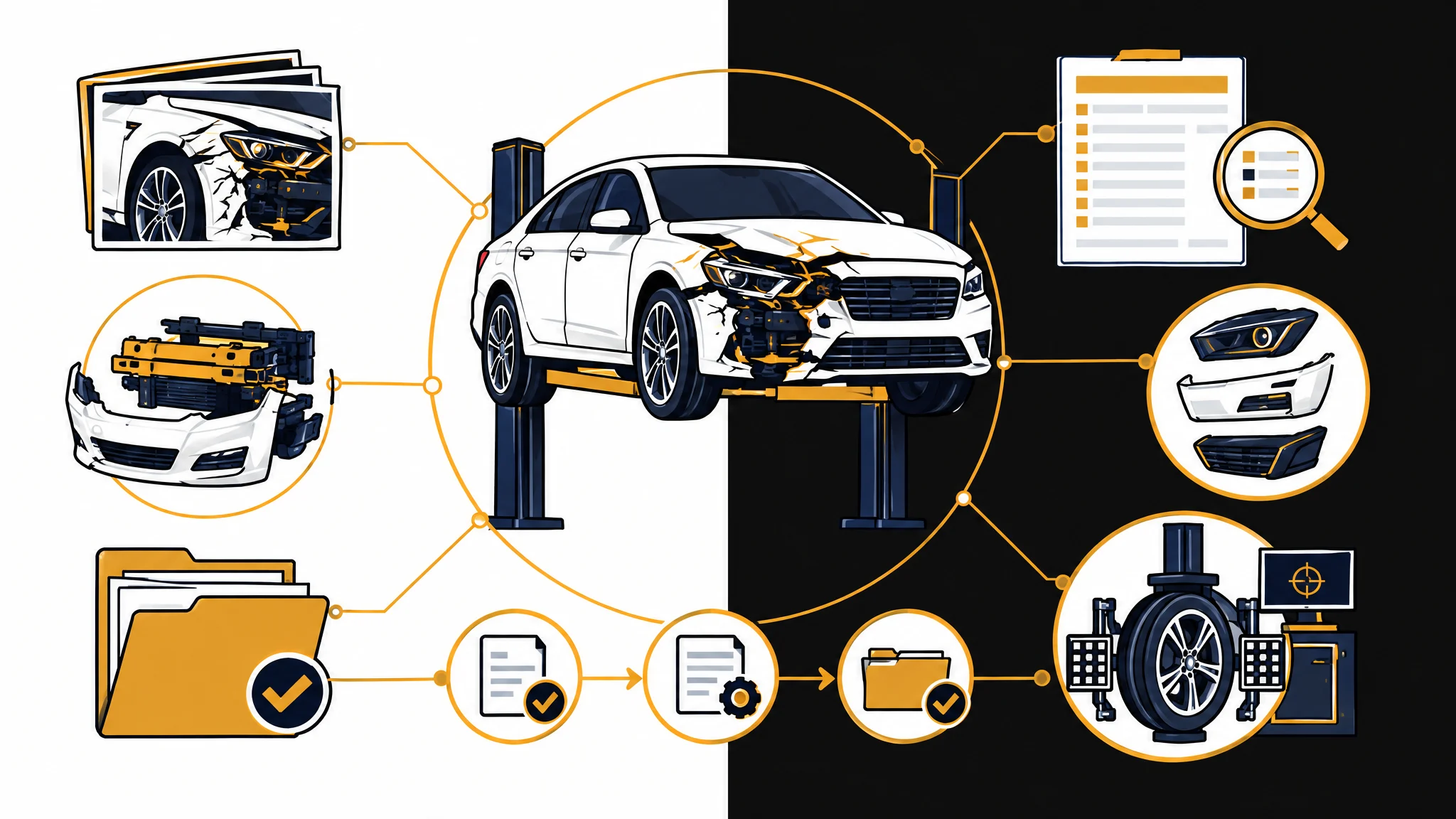
A car accident repair estimate is a starting scope, not proof that every collision-related repair has already been found or approved. Check the vehicle identity, damaged areas, labor operations, parts, refinishing, diagnostic work, safety-system procedures, taxes, fees, and exclusions. Then preserve each supplement so the final invoice can be traced back to newly documented damage rather than an unexplained higher total.
This guide focuses on the estimate itself. For the larger vehicle file, including towing, rental, total-loss valuation, and release review, use the car accident property damage claim checklist.
Confirm the estimate belongs to the right vehicle and loss
Start with the header before reviewing prices. Confirm:
- owner and claimant name;
- claim number and collision date;
- vehicle identification number, year, make, model, trim, mileage, and options;
- impact area and inspection date;
- shop, estimator, insurer, and estimate version; and
- whether the estimate is preliminary, approved, partly approved, or informational.
A wrong trim, missing option, old mileage figure, or incomplete impact description can affect parts, procedures, calibration needs, and total-loss analysis. Photograph the VIN plate, odometer, dashboard warnings, every side of the vehicle, and the damaged area before repairs change the condition.
Read the car accident repair estimate line by line
Do not review only the bottom-line amount. An estimate is a sequence of operations. Group each line into a repair category:
| Estimate category | What to identify | Control question |
|---|---|---|
| Body and structural | Repair, replace, measure, pull, weld, corrosion protection | Does the operation match the documented damage and repair procedure? |
| Mechanical | Suspension, steering, cooling, exhaust, electrical | Was the affected system inspected or tested by a qualified facility? |
| Refinish | Paint labor, materials, blend panels, masking | Does the refinishing scope follow the panels being repaired or replaced? |
| Parts | New OEM, aftermarket, recycled, remanufactured, existing | Is the part type clearly identified and supported by the policy or repair position? |
| Diagnostics | Pre-scan, post-scan, measurements, road test | What result is expected, and where will it be recorded? |
| Safety systems | Alignment, sensor aiming, camera or radar calibration | Which vehicle-specific procedure supports the operation? |
| Charges | Labor rates, materials, sublet work, tax, disposal or shop fees | Is each charge itemized rather than hidden in a round total? |
A low estimate is not automatically wrong, and a high estimate is not automatically complete. The useful question is whether every operation has a source: visible damage, teardown photo, diagnostic result, measurement, manufacturer procedure, or qualified repair judgment.
Separate visible damage from hidden damage
The first inspection may occur while bumper covers, lamps, trim, wheel liners, or interior panels remain installed. Additional damage may appear after controlled disassembly. That can include broken brackets, absorber damage, wiring, cooling components, suspension issues, or deformation not visible in exterior photos.
Ask the shop to photograph newly exposed damage before it is repaired. The record should show:
- where the new damage was found;
- how it relates to the collision area;
- which original estimate line was affected;
- what new operation or part is requested; and
- whether work is paused pending authorization.
Do not discard the first estimate when a supplement is issued. Number the versions so the file shows how the scope changed.
Treat supplements as change records
A supplement should explain a difference, not merely present a new total. Build a comparison sheet:
| Version | New finding | Added or changed operation | Amount change | Approval status |
|---|---|---|---|---|
| Initial estimate | Visible exterior damage | Initial repair plan | ||
| Supplement 1 | Teardown finding | Part or labor change | ||
| Supplement 2 | Diagnostic or measurement result | Added procedure | ||
| Final invoice | Completed work | Actual billed scope |
Save insurer approvals, partial approvals, denials, shop notes, and revised completion dates. If an item is disputed, ask for the repair, policy, factual, or pricing reason in writing.
Check parts descriptions and repair methods
The estimate should identify whether a part is original equipment, aftermarket, recycled, reconditioned, or another category used by the estimating system. Those labels matter because price, availability, fit, warranty, and repair procedure may differ.
Do not assume that every damaged component must be replaced or that every replacement must be new OEM. Ask the shop what repair procedure it proposes and ask the insurer what policy or claim basis supports its parts position. If there is a price difference, record who is expected to pay it before the part is ordered.
The Nevada Division of Insurance explains that collision loss settlement may involve repair or replacement with like kind or quality, subject to the policy. Nevada claim standards also state that an insurer-prepared estimate should be an amount for which the damage can reasonably be expected to be satisfactorily repaired. These are review points, not guarantees that every proposed shop charge is covered.
Verify scans, alignment, and calibration records
Modern vehicles may use cameras, radar, parking sensors, steering-angle sensors, restraint systems, and other electronic controls. A collision, part replacement, wheel alignment, or panel position can affect which procedures apply.
Ask for vehicle-specific documentation rather than assuming every car requires the same package. The repair file may include:
- pre-repair and post-repair scan reports;
- wheel-alignment measurements;
- calibration prerequisites and completion results;
- diagnostic trouble-code explanations;
- sublet invoices from a qualified provider; and
- road-test or quality-control notes.
A line item labeled “scan” or “calibration” does not prove the procedure was completed. Match it to a result, invoice, or completion record.
Know your Nevada repair-shop choice rights
Nevada’s automobile claim standards state that an insurer may not require a claimant to travel unreasonably to obtain an estimate or have the vehicle repaired at a specific shop. Nevada law also provides a right to choose a licensed body shop and requires notice of that right when the insurer is first contacted about the damage.
Shop choice and payment responsibility are separate issues. Before authorizing work, ask whether the insurer and shop agree on labor rates, parts, procedures, storage, teardown, diagnostics, and supplements. If they disagree, request the disputed line items and each side’s written position.
Reconcile the final invoice before taking delivery
The final invoice should match the work actually performed. Compare it against every estimate and supplement:
- Were all approved operations completed?
- Were any parts changed from the approved description?
- Do parts invoices and sublet charges match the billed lines?
- Are scans, measurements, alignment, and calibration results included?
- Were prior payments, deductible, tax, and customer-pay items applied correctly?
- Is any disputed or unfinished work still listed as complete?
At pickup, inspect panel fit, finish, lamps, warning lights, steering, braking, sensors, and obvious new damage. Report concerns promptly and ask the qualified repair facility to inspect them. Do not diagnose structural, mechanical, or electronic problems from appearance alone.
If a properly repaired vehicle may still have a measurable market-value loss, review the separate diminished value claim guide. Do not add a guessed diminished-value number to the repair invoice.
Close the repair file with seven matching records
Before treating the vehicle repair as complete, confirm that these records agree:
- pre-repair photos and vehicle identity;
- initial insurer and shop estimates;
- teardown and diagnostic evidence;
- every supplement and approval decision;
- parts, sublet, scan, alignment, and calibration records;
- final invoice and payment breakdown; and
- delivery inspection, warranty, and unresolved-issue notes.
If an estimate dispute, unsafe repair concern, or broad release is complicating an injury claim, start the 60-second case evaluation and bring the complete repair file.
This article provides general information, not legal, insurance, or repair advice. Coverage, repair obligations, shop responsibility, parts, procedures, payment, deadlines, and legal rights depend on the policy, current law, jurisdiction, vehicle, documents, and specific facts.
Frequently Asked Questions
Why can a car accident repair estimate increase after work begins? +
The first estimate may cover only visible damage. After disassembly, scanning, measuring, or testing, the shop may document additional collision-related damage and submit a supplement for review.
What should I compare between the insurer estimate and the body shop estimate? +
Compare vehicle identity, damaged areas, labor operations and rates, repair-versus-replace decisions, parts type, refinishing, scans, alignment, calibration, fees, taxes, and any item marked unsupported or pending.
Can an insurer require a specific repair shop in Nevada? +
Nevada claim standards state that an insurer may not require a claimant to travel unreasonably or have the vehicle repaired at a specific shop. Nevada also recognizes a claimant's right to choose a licensed body shop, subject to policy terms and claim facts.
What should I save after the vehicle is repaired? +
Save every estimate and supplement, damage and teardown photos, approvals, parts invoices, scans, measurements, calibration and alignment records, the final invoice, payment breakdown, warranty, and written notes about unresolved concerns.
Injured in a Las Vegas accident?
Find out what your case is worth in under 60 seconds. Free, confidential, no obligation — and no fee unless we win.
Check My Case in 60 Seconds